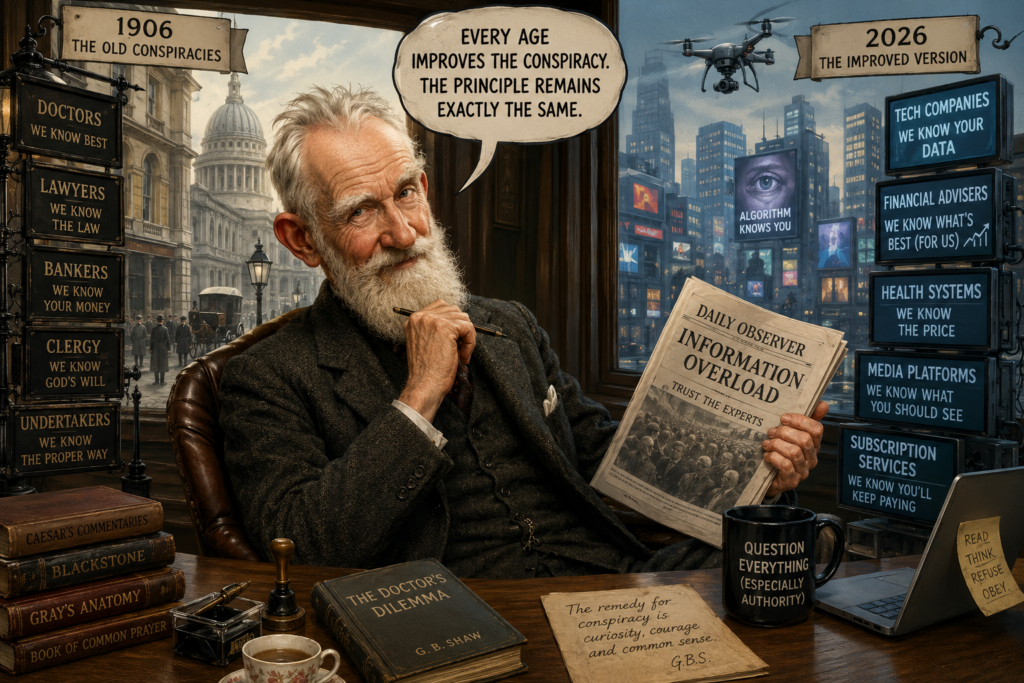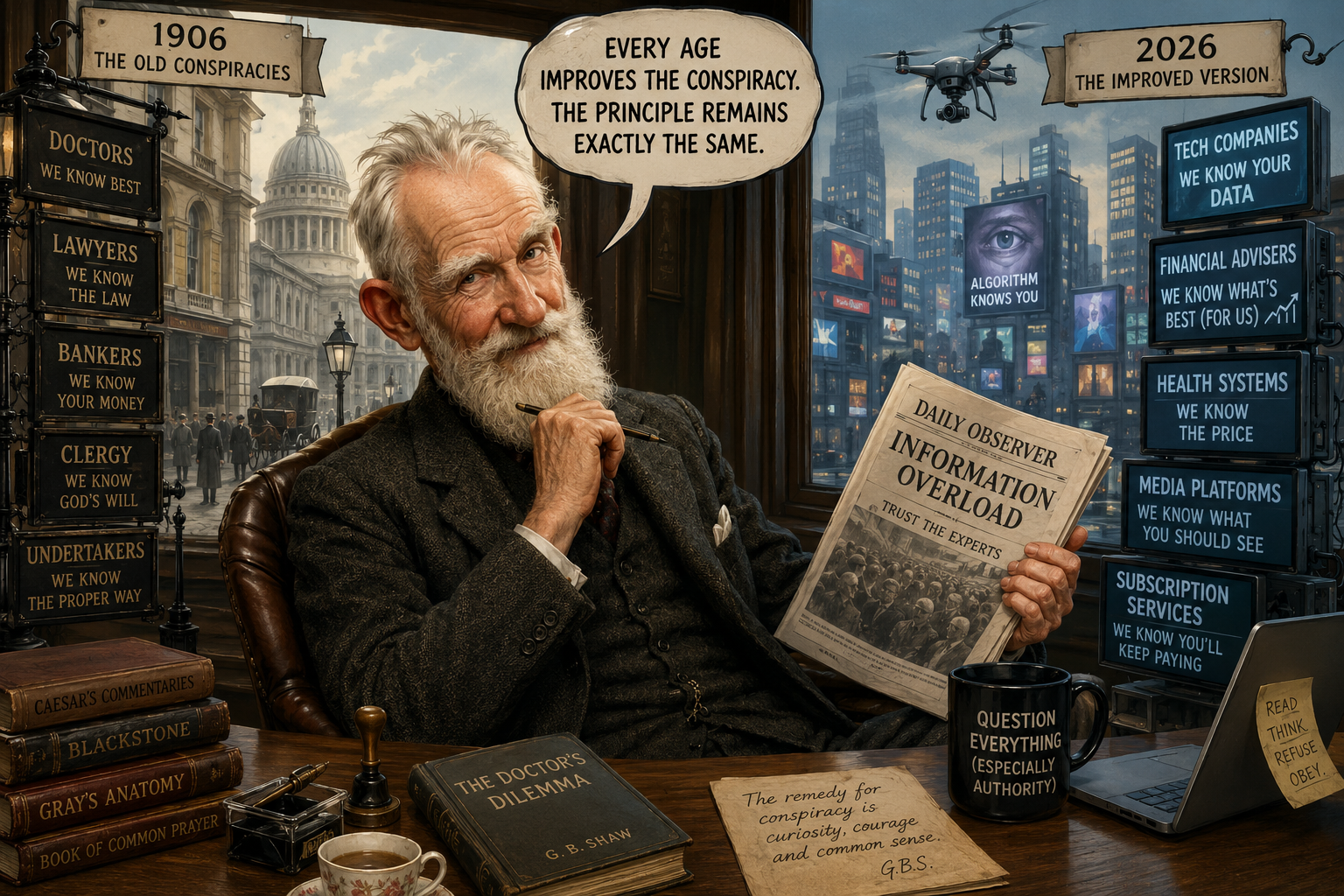

George Bernard Shaw once wrote: “All professions are conspiracies against the laity.”
That was in The Doctor’s Dilemma, first produced in 1906.
Shaw wasn’t suggesting that doctors, lawyers and undertakers gathered in dark basements after work to discuss how best to fleece the public.
His point was considerably more dangerous.
A profession begins with knowledge.
Then it develops a vocabulary.
Then qualifications.
Then rules.
Then organizations to enforce the rules.
Eventually the ordinary citizen is told:
You couldn’t possibly understand this.
Fortunately, there is someone who does.
And he charges by the hour.
1906
Shaw had plenty of evidence.
Consider the doctor.
Medicine was becoming scientific, but the physician still occupied something close to a priesthood. He spoke a language the patient didn’t understand, wrote prescriptions in Latin and generally expected his conclusions to be received with gratitude rather than questions.
If two doctors disagreed, this did not necessarily diminish the authority of either doctor.
It merely meant you needed a third doctor.
Then there were lawyers.
British law had accumulated centuries of precedents, procedures, peculiar terminology and Latin expressions.
In theory, the law belonged to everyone.
In practice, understanding it required hiring someone who had spent years learning the language in which it had been deliberately—or at least magnificently—complicated.
Bankers were getting into the act.
Money was becoming surrounded by mortgages, securities, interest calculations, commissions and financial instruments understood rather better by the gentleman behind the desk than by the gentleman whose money was on the desk.
Religion had its professionals too.
God may have created mankind, but mankind soon developed a substantial administrative department to explain what God had meant.
And even death became too complicated for amateurs.
The undertaker could transform the fairly straightforward condition of being dead into an impressive commercial transaction involving coffins, hearses, flowers, clothing, etiquette and several grades of respectability.
By the beginning of the twentieth century, you apparently needed professional assistance simply to stop existing.
Shaw thought this was hilarious.
Then he died in 1950.
Which was unfortunate.
Because he missed the really good stuff.
2026
If Shaw returned today, the first thing we would probably have to explain to him is the subscription.
In Shaw’s world, you bought something.
Then—and this will sound radical—you owned it.
Today we subscribe to music, movies, newspapers, software, cloud storage, security systems and countless other services.
The great commercial breakthrough of our age has been discovering that selling something to a customer once is terribly inefficient.
Far better to sell it to him every month for the rest of his life.
Even automobiles have begun acquiring features that can be switched on and off electronically.
We have therefore achieved something Shaw might have considered impossible:
You can buy something and still not entirely own it.
He would adore modern finance.
We now have financial advisers, wealth managers, analysts, planners, fund managers, consultants, algorithms and an alphabet soup of financial products designed to help ordinary people do something their grandparents called saving money.
Shaw would ask one wonderfully impolite question:
Does all this complexity make the customer richer—or the financial industry?
Then we could show him medicine.
He would be astonished.
We can replace joints, transplant organs, peer inside the human body, manipulate genes and keep alive people who would have been beyond hope in Shaw’s lifetime.
He would celebrate the science.
Then he would meet the billing department.
Medicine now involves physicians, specialists, hospitals, laboratories, pharmaceutical companies, insurers, administrators, diagnostic companies and computer systems.
Shaw might wonder how humanity managed to make curing one sick person require quite so many healthy ones.
But technology would be his masterpiece.
We carry devices in our pockets possessing capabilities beyond anything Shaw could have imagined.
They can photograph our grandchildren, translate languages, navigate across continents and summon practically the accumulated knowledge of civilization.
We frequently cannot change their batteries.
We don’t know what information they’re collecting.
We don’t know where that information goes.
We can’t repair them.
And when they stop working, we’re directed to an online support page—which we may need the malfunctioning device to reach.
Technology began by promising to eliminate our dependence on experts.
It has ended by making us dependent upon experts we aren’t even allowed to telephone.
And then Shaw would encounter the greatest conspiracy of all.
THE ALGORITHM
In 1906 the professional could say:
Trust me. I understand this and you don’t.
In 2026 he has an even better answer:
Don’t ask me. The computer decided.
Algorithms increasingly determine what news reaches us, which advertisements pursue us, what entertainment is suggested to us, whether we are considered good credit risks and what information appears when we search for something.
The remarkable thing is that sometimes the people operating these systems cannot fully explain an individual result either.
We have therefore invented the perfect bureaucracy.
One in which even the bureaucrat can blame somebody else.
And the somebody else isn’t a somebody.
It’s software.
SHAW’S REAL WARNING
Shaw wasn’t arguing against expertise.
He wasn’t suggesting that we perform our own appendectomies, draw up our own bridges or represent ourselves in murder trials after watching three instructional videos.
His target was unquestioned authority.
Expertise is enormously valuable.
Mystification isn’t.
The danger begins when specialized knowledge becomes specialized language, specialized language becomes exclusion, exclusion becomes power—and the person paying the bill becomes embarrassed to ask what the hell is going on.
There is one fascinating difference between Shaw’s world and ours.
In 1906, power frequently came from withholding information from ordinary people.
In 2026, information is everywhere.
We are buried in it.
The modern struggle is increasingly over who selects it, ranks it, interprets it and decides which tiny portion of it appears before our eyes.
Perhaps Shaw’s famous observation therefore needs a small update:
“All professions are conspiracies against the laity.”
And, after looking around 2026, perhaps he would add:
“The modern improvement is that the laity now pays a monthly fee to participate in the conspiracy.”
Shaw didn’t write that last line.
Unfortunately.
He died before subscriptions.