If I could travel back in time, I wouldn’t kill anybody.
That seems terribly rude.
Besides, killing somebody in 1914 might mean that your grandmother marries somebody else in 1937, which means your mother is never born, which means you aren’t here to read this.
Time travel requires restraint.
I would make tiny adjustments.
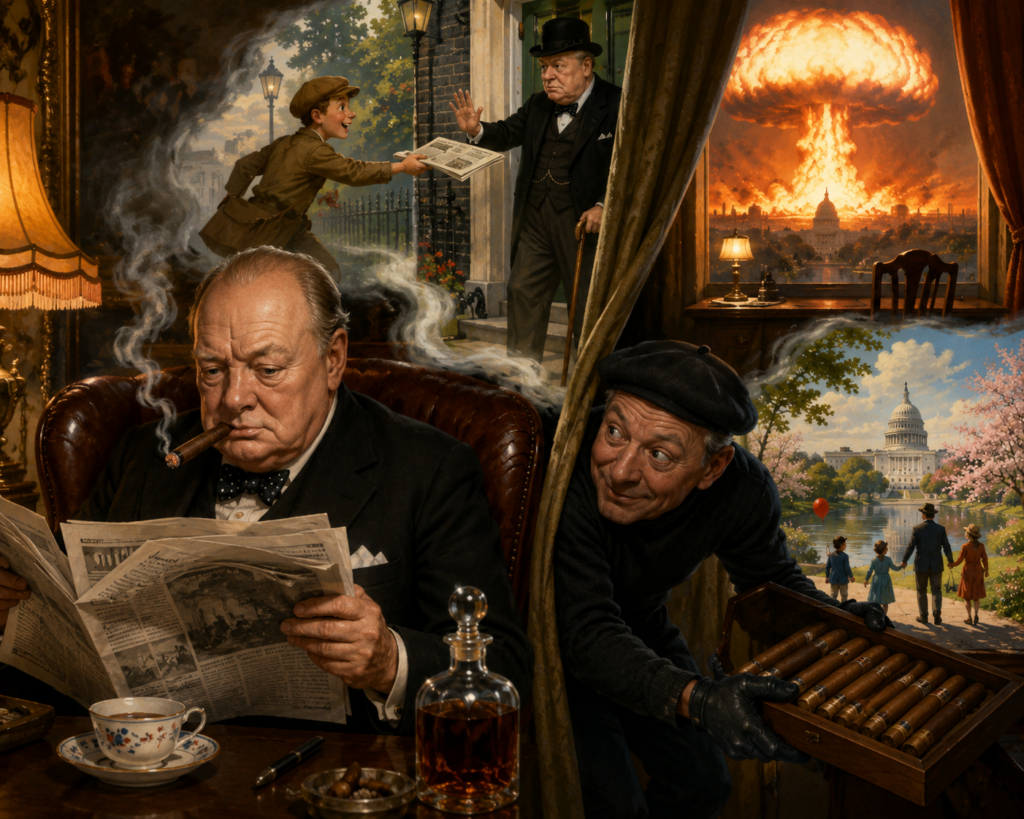
Let’s suppose Winston Churchill had decided to drop an atomic bomb on Washington, D.C.
He hadn’t, of course.
But this is my time machine, so bear with me.
Suppose Churchill got the idea from a newspaper article arguing that the only sensible way to deal with America was to vaporize Washington.
The paperboy delivered that newspaper every morning at precisely 7:15.
Churchill always bought one while taking his morning walk.
So I wouldn’t shoot Churchill.
I wouldn’t shoot the paperboy.
I wouldn’t even steal the newspaper.
I’d sneak into Churchill’s house and steal his cigars.
Churchill would spend two minutes looking for them.
The paperboy would pass.
Churchill would never read the article.
Washington would survive.
I would return to the present, pour myself a drink and try not to look smug.
This raises an interesting question.
How much of history could be changed by moving something six inches?
The Wrong Turn
June 28, 1914.
Sarajevo.
Archduke Franz Ferdinand is riding through the city when Serbian nationalists attempt to assassinate him.
They fail.
One throws a bomb. It misses Franz Ferdinand’s automobile.
You would think history had just dodged a bullet.
It hadn’t.
Later that morning, Franz Ferdinand’s driver took a wrong turn.
When he realized his mistake, he stopped and tried to back up.
And by one of history’s most astonishing coincidences, standing nearby was Gavrilo Princip, one of the assassins from the failed plot.
Princip suddenly found himself only a few feet from the Archduke.
He fired.
Franz Ferdinand and his wife Sophie died.
Austria-Hungary blamed Serbia.
Russia mobilized.
Germany mobilized.
France and Britain entered.
Europe exploded.
World War I killed millions.
The war helped create the conditions for Hitler, Nazi Germany, World War II and another mountain of corpses.
So where do I go with my time machine?
Not to Princip.
I go to the driver.
Five minutes before departure, I put a tack under one of his automobile tires.
Nothing dramatic.
Just enough to cause a slow leak.
Someone notices.
The car is delayed.
Perhaps they use another car.
Perhaps another driver takes the wheel.
Perhaps they leave three minutes later.
Whatever happens, Franz Ferdinand doesn’t arrive at that particular street corner at that particular second.
Princip goes home.
History takes a different street.
Hitler’s Train
Now let’s try Hitler.
I’m certainly not going to shoot him.
Everybody shoots Hitler in time-travel stories.
No imagination.
Instead, I go to November 1923.
Hitler and his followers are preparing what became known as the Beer Hall Putsch, their attempt to seize power in Bavaria.
The coup fails.
Hitler is arrested.
He goes to prison.
And prison turns out to be rather useful to him.
He becomes famous.
He dictates Mein Kampf.
His trial gives him national publicity.
The failed revolutionary eventually decides that gaining power through elections might work better than gaining it through gunfire.
So I don’t kill Hitler.
I arrange for him to miss the putsch.
How?
His automobile won’t start.
I have removed one tiny wire.
Hitler spends twenty furious minutes yelling at the chauffeur.
By the time he gets where he’s going, the crucial moment has passed.
Maybe the coup collapses without him.
Maybe there’s no spectacular trial.
No national platform.
No heroic mythology for his followers.
Perhaps Hitler remains what he had been only a few years earlier: an angry little man nobody particularly wanted to listen to.
One wire.
Millions of lives.
Not bad work for an afternoon.
Hiroshima
August 1945.
President Harry Truman has already authorized the use of atomic weapons against Japan.
I don’t try to change Truman’s mind.
I don’t sabotage the bomb.
That could get complicated very quickly.
Instead, I visit Hiroshima.
On August 6, the city was selected partly because weather conditions permitted visual bombing.
Cloud cover mattered.
So I don’t touch the Enola Gay.
I don’t touch the bomb.
I don’t touch Truman.
I alter a weather report.
One clerk receives the wrong sheet.
One observation is copied incorrectly.
One message says:
Cloud cover over Hiroshima.
The mission turns toward another target.
Hiroshima wakes up the following morning.
Now, this doesn’t magically end the war.
Another city might suffer instead.
Japan might surrender later.
More soldiers might die.
The Soviet invasion of Manchuria might become even more decisive.
That’s the frightening thing about changing history.
You know what you’re preventing.
You don’t know what you’re creating.
Which is why, after three trips, I think I would park the time machine.
Because history isn’t a row of dominoes.
It’s a room containing several billion mousetraps, each loaded with a ping-pong ball.
Touch one and God knows where everything lands.
Still, I would keep the keys.
Just in case.
And if I ever learned that civilization ended because some powerful man read something idiotic in the morning newspaper, I wouldn’t kill him.
I’d steal his cigars.
Two minutes ought to do it.