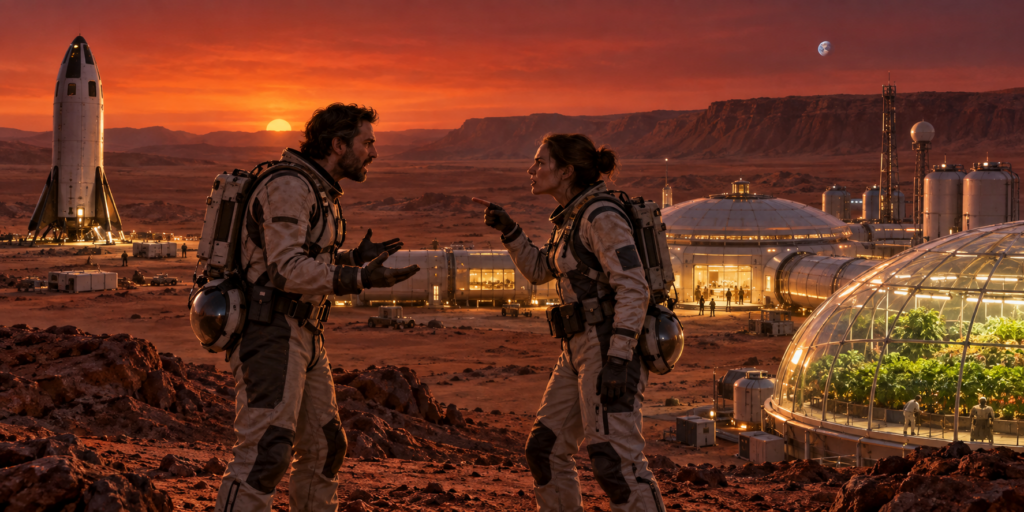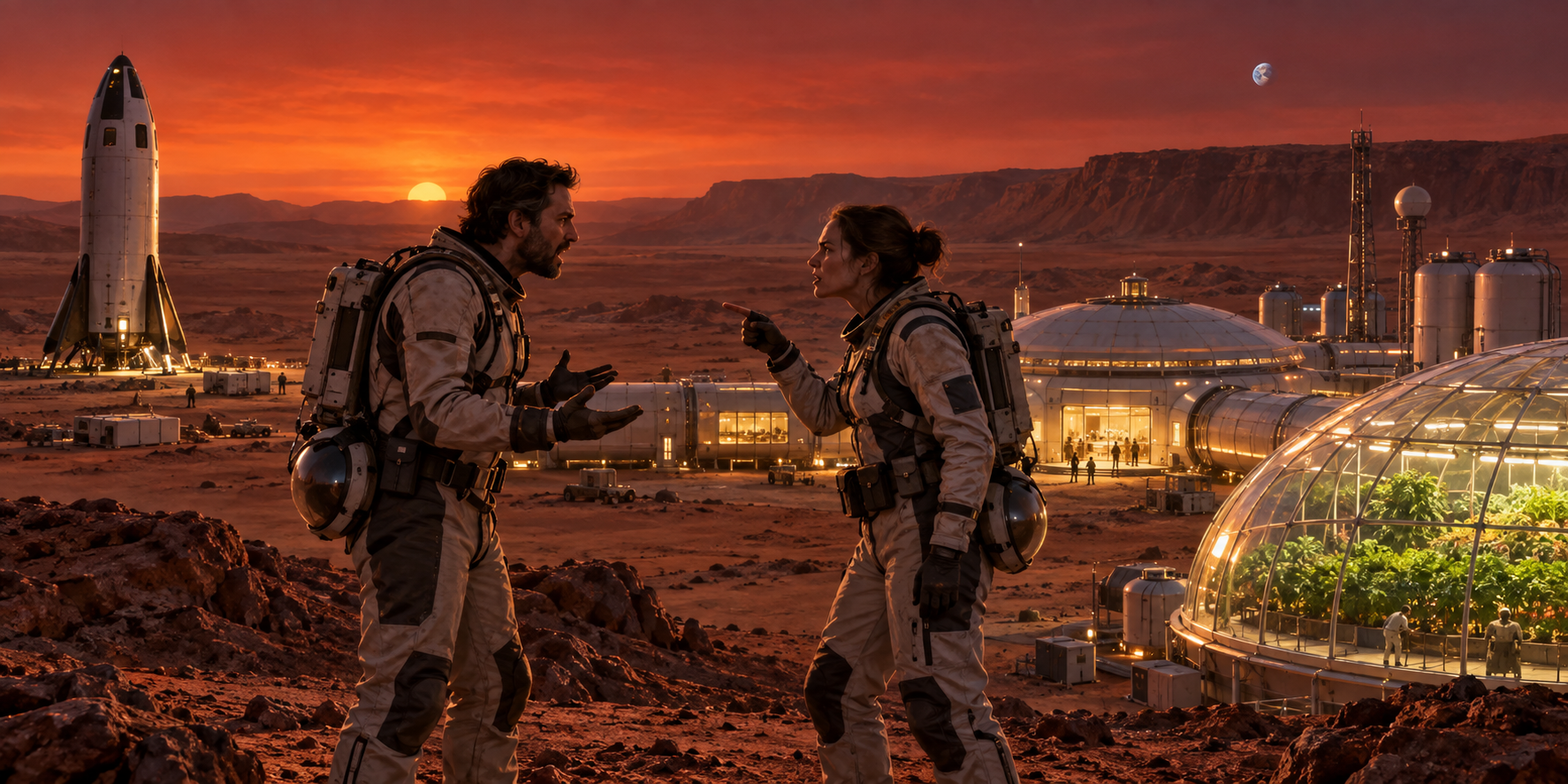

Before humans could colonize Mars, they had to solve three enormous problems.
The first was getting there.
The second was staying alive.
The third was other people.
Naturally, the first two proved easier.
Getting There
Mars is roughly thirty-four million miles from Earth when the two planets are feeling sociable. At other times, it is more than two hundred million miles away.
This makes Mars an inconvenient destination. There are no direct flights, no roadside motels and absolutely no place to stop for coffee.
The first colonists spent months sealed inside a metal cylinder hurtling through space. They lived on dehydrated food, recycled water and the assurance of engineers that every important component had been tested.
Almost every important component.
After decades of exploding prototypes, missed calculations and congressional hearings, humans finally built spacecraft capable of carrying passengers to another planet and landing them in approximately the same number of pieces in which they had departed.
This was hailed as a triumph.
The astronauts emerged onto the Martian surface, planted a flag and took several photographs before admitting that nobody had brought the proper attachment for the flagpole.
Still, they had arrived.
Problem One had been solved.
Staying Alive
Mars was not immediately welcoming.
The atmosphere was nearly all carbon dioxide. The temperature could fall low enough to freeze a tax auditor. Radiation poured down from space, the soil contained toxic chemicals and the nearest hospital was several million miles away.
Even the view became tiresome. Mars offered rocks, dust and occasionally a slightly different arrangement of rocks and dust.
Nevertheless, humans went to work.
They built sealed habitats beneath layers of Martian soil. They manufactured oxygen from the atmosphere, extracted water from underground ice and generated power from solar panels that had to be dusted every seventeen minutes.
They grew vegetables beneath glass.
The first Martian tomato cost approximately eight million dollars and tasted like a damp golf ball, but everyone agreed it was delicious because funding for the greenhouse depended upon it.
Eventually, the colony produced enough air, water, food, heat and electricity to sustain several hundred people.
There were occasional emergencies. A cracked seal nearly emptied one habitat. A failed heater almost froze another. Once, the entire colony lost power because somebody plugged an electric kettle into the wrong socket.
But the engineers fixed everything.
They always did.
Problem Two had been solved.
Living Together
The final challenge appeared deceptively simple.
The colonists had to live together.
They had been carefully selected. Each was intelligent, healthy, highly trained and psychologically stable.
Within three weeks, half of them were no longer speaking to the other half because someone had used the last of the coffee and returned the empty container to the cupboard.
A committee was formed.
The committee created rules governing coffee, showers, noise, laundry, romantic relationships, thermostat settings and the acceptable duration of conversations about life on Earth.
A second committee was then formed to investigate why the first committee had exceeded its authority.
Political parties appeared.
One demanded complete independence from Earth. Another insisted that Earth should continue paying for everything. A third believed Mars belonged to the Martians, although no Martians had been discovered and therefore could not be consulted.
The greenhouse workers accused the engineers of stealing tomatoes.
The engineers accused the scientists of wasting electricity.
The scientists accused everyone else of being too stupid to understand why the electricity was necessary.
Two colonists stopped speaking after an argument over whether the settlement should be called New Earth, Mars City or Brad.
Brad had suggested Brad.
The psychologists organized weekly sessions to reduce tension. Attendance was mandatory, which immediately increased tension.
Meanwhile, every message to Earth was carefully edited.
“The colony continues to function beautifully,” one official report announced, moments after somebody threw a hydroponic cucumber across the dining hall.
The founders had imagined that humanity would leave its old divisions behind.
They were right.
Humanity left the divisions behind, packed them into storage containers and transported them to Mars at enormous public expense.
The colonists had conquered distance. They had defeated cold, radiation, starvation and thirst. They could manufacture oxygen from poisonous air and coax vegetables from alien soil.
They had solved space travel.
They had solved survival.
In the end, the only thing the humans could not control was themselves.
Every human being on Mars was dead.
They had not been killed by radiation, starvation, equipment failure or the almost complete absence of oxygen.
They had killed one another.
Meanwhile, back on Earth, the standard of living had collapsed. The Mars experiment had consumed nearly one hundred trillion dollars—most of it borrowed, all of it spent within twelve years.
Schools had closed. Hospitals had run out of medicine. Millions of people were hungry. Humanity had sacrificed the welfare of one planet in order to place several hundred highly educated lunatics on another.
The UN took decisive action.
It passed a law making it a criminal offence, punishable by one year in prison, to refer to Mars as the Red Planet.
Red, officials explained, was an accounting term associated with catastrophic financial loss. Hearing it reminded impoverished taxpayers of the hundred trillion dollars they had spent sending humanity’s finest minds to another planet so they could murder one another over coffee, tomatoes and the thermostat.
Several weeks later, the word red itself was banned.
Red paint was destroyed. Red traffic lights were replaced with purple ones. Children were forbidden to own red crayons. Roses became officially burgundy.
Mars, however, remained red.
It had declined to cooperate.