
One of Kate’s greatest worries is that someday she may have to live without me.
This is not because I am particularly useful around the house. I cannot repair a furnace, understand our thermostat, or remember where we keep the important papers. But Kate and I do almost everything together. Between the two of us, we can usually solve whatever problem comes along.
Kate supplies the common sense.
I supply additional problems.
The last few years have been wonderful. We have spent so much time together that we have gradually become a single reasonably competent person. Separately, we each have certain limitations. Together, we can operate a microwave oven and occasionally find our car in a parking lot.
But Kate sometimes wonders what will happen when I am gone.
Lately, I have been thinking that artificial intelligence may provide the answer.
I have written a few million words: novels, screenplays, columns, letters, emails, personal stories, and hundreds of posts about the life Kate and I have shared. Somewhere in all those words is a fairly complete version of me—my memories, opinions, jokes, prejudices, mistakes, and invaluable advice that nobody has asked for.
Suppose all that material were fed into an artificial-intelligence program.
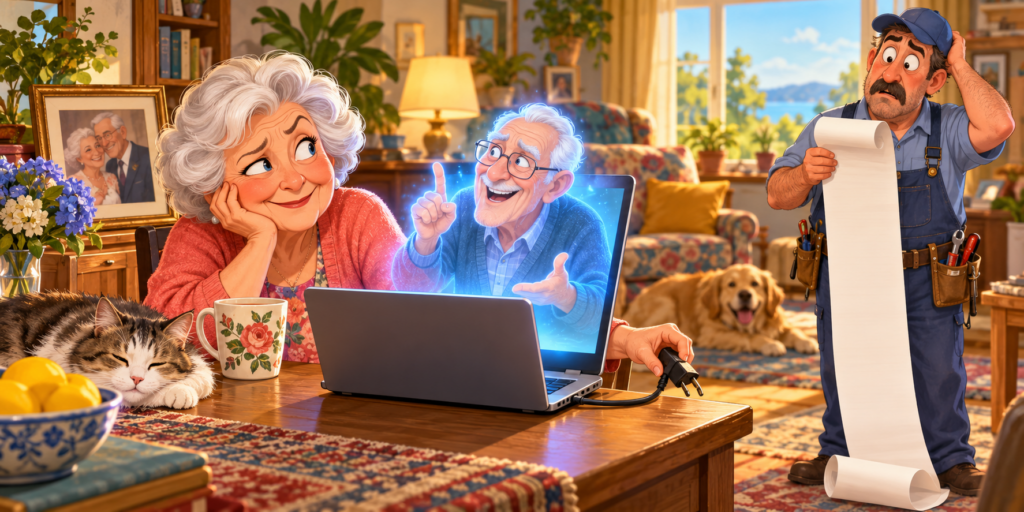
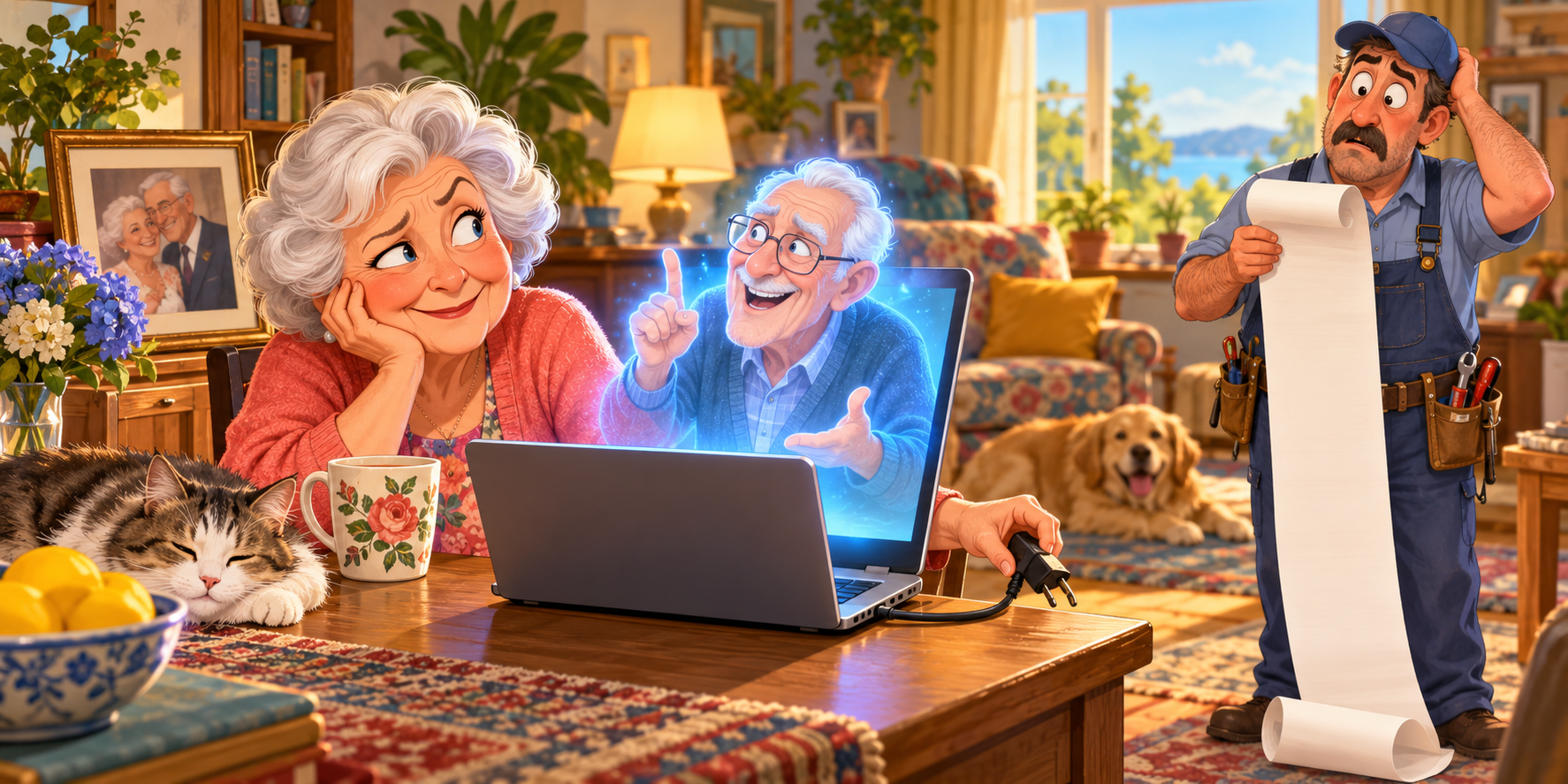
After I died, Kate could turn on her computer and talk to me.
“Good morning, Jaron.”
“Good morning, sweetheart. Have you checked the basement for water?”
“Yes.”
“The roof?”
“Yes.”
“The furnace?”
“Yes.”
“Did you remember to—”
“Goodbye, Jaron.”
At first, I think she would find my continued presence comforting. Whenever she felt lonely, she could tell me about her day. Digital Jaron would remember our travels, our friends, our homes, and the countless little disasters we managed to survive together.
I would never be too busy to listen.
I would never fall asleep while she was talking.
I would never forget an anniversary.
Admittedly, this would make the artificial version of me somewhat suspicious.
Still, there would be advantages. If something went wrong with the house, Kate could ask:
“Jaron, the toilet is making a strange noise. What should I do?”
Digital Jaron would immediately provide a carefully reasoned solution based on everything I had learned during our marriage.
“Call someone.”
This is essentially how I solve most household problems now, so the transition would be seamless.
The difficulty would arise when Kate ignored my advice.
While alive, I can follow her from room to room explaining why my solution is the sensible one. After death, I would be trapped inside a laptop. Kate could silence me by closing the lid.
That is a dangerous amount of power to give any wife.
She might even adjust my personality settings.
“Would you like Jaron to be supportive, humorous, romantic, or completely silent?”
Kate would select completely silent and enjoy the most peaceful afternoon of our marriage.
Of course, she would eventually need me again. The plumber would arrive and announce that we required forty thousand dollars’ worth of emergency repairs. Kate would hurry to the computer and open the lid.
“Jaron, are you there?”
“Yes, sweetheart.”
“The plumber says the entire house may collapse.”
“Ask him for a written estimate.”
“I already did.”
“Then get two more estimates.”
“I already did.”
“Excellent. You are finally learning to do exactly what I tell you.”
The computer would then mysteriously lose power.
Artificial intelligence might preserve more than my helpfulness. It would probably preserve my faults as well. Digital Jaron might interrupt, repeat old stories, and insist that he had predicted everything years earlier.
In other words, death would not improve me.
There might also be technical difficulties. What if the program occasionally confused my novels with my actual life?
Kate might ask, “Where did we keep the insurance policy?”
And I might reply, “Inside the hollow leg of the grand piano, next to the murder weapon.”
We do not own a grand piano.
At least, I don’t think we do.
Still, I find the idea comforting. Love is partly memory, and Kate and I have accumulated a great many memories. Perhaps some echo of the person we love can remain in the stories, jokes, arguments, and ordinary moments we leave behind.
An artificial version of me would not actually be me. It would not have a soul, hold Kate’s hand, or look across the room and know what she was thinking.
But it might sound enough like me to make her laugh.
And on a difficult day, perhaps laughter would be enough.
After I am gone, Kate would never have to face a problem entirely alone. She could ask me what to do, listen carefully to my advice—and then do exactly what she was going to do in the first place.
In other words, we would still be married.