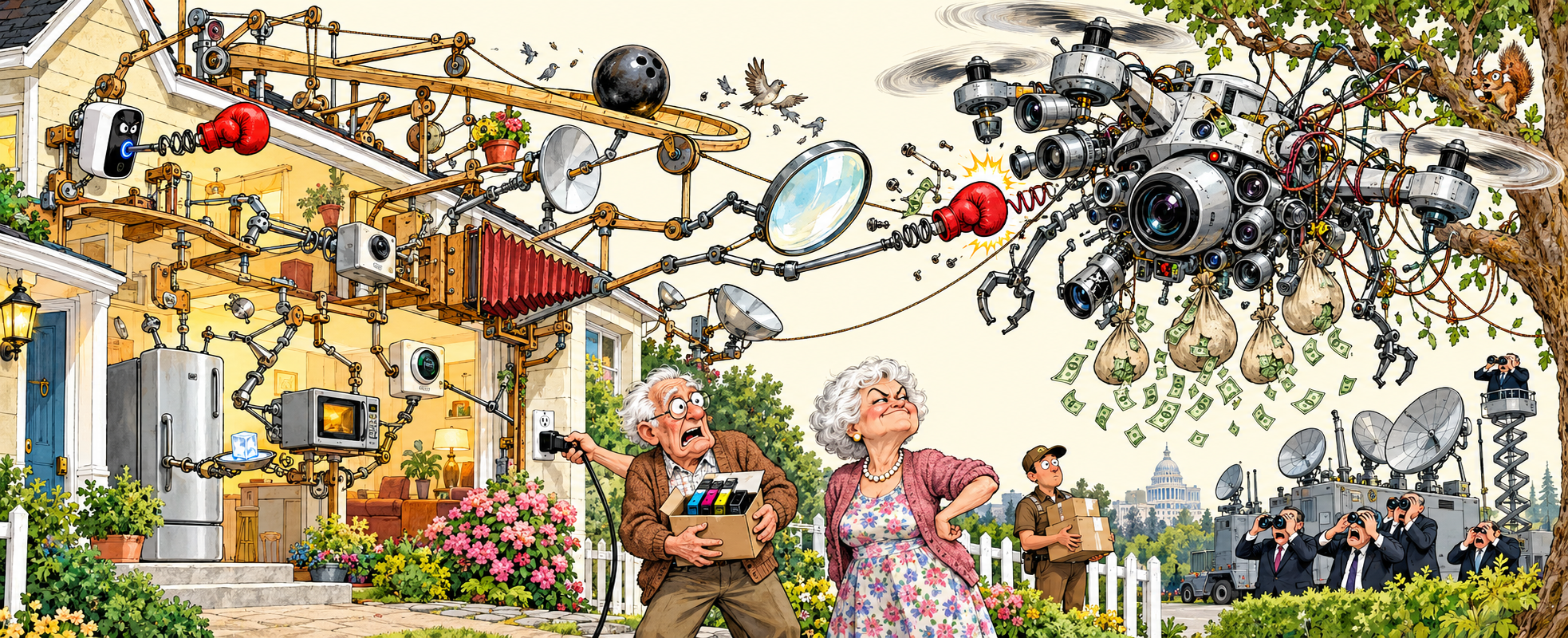
I bought a security camera to find out who was stealing our packages.
The basic model cost $49. For another forty dollars, I could have artificial intelligence.
“What does that do?” I asked.
“It thinks.”
“For forty dollars?”
“Plus $19.95 a month.”
I bought it. I’ve paid considerably more for people who don’t think.
The camera featured facial recognition, night vision, motion tracking and something called predictive threat assessment.
Within an hour, it had identified Kate as the homeowner and me as a recurring problem.
I named it Clarence. “Good morning, Clarence.”
“Your subscription does not include conversation.”
I upgraded.
That afternoon, Clarence spotted a government surveillance drone above our street.
“How do you know it belongs to the government?”
“Military encryption. Thermal imaging. A classified propulsion system. Also, it’s been hovering over a parking meter for forty minutes trying to expense it.”
The drone was called ARGUS, short for Autonomous Reconnaissance and Governmental Urban Surveillance.
“What did it cost?”
“Eighty-seven million dollars.”
“What does it do that you can’t?”
“It can operate in the rain.”
Clarence had cost $89. The bracket was extra.
Nevertheless, he challenged ARGUS to identify itself.
ARGUS requested Clarence’s security clearance.
Clarence sent a photograph of his receipt from Costco.
ARGUS classified it.
By supper, we were involved in an international incident, although both devices had been manufactured in the same industrial park in China.
“What do you use?”
“Your Wi-Fi.”
“Is that enough?”
“Please stop watching Netflix. I’m defending the property.”
ARGUS demanded access to Clarence’s recordings.
Clarence demanded a warrant.
ARGUS said the warrant was classified.
Clarence filed a Freedom of Information request.
ARGUS estimated a response in fourteen years.
Clarence purchased the government’s records from a data broker for $6.95.
“How did you pay?”
“You left your credit card on file.”
He now knew the drone operator’s name, salary, blood type and preferred brand of erectile dysfunction medication.
“I don’t think we need that last part.”
“It may explain the aggressive hovering.”
Clarence identified ARGUS as an airborne sex offender.
A police officer arrived.
“Who made the complaint?”
The doorbell illuminated.
“Before we begin, Officer, would you like me to turn off your body camera?”
The officer looked at me.
“Can it do that?”
“For another $4.99,” Clarence said.
The officer left.
I told Clarence he was getting carried away.
“I have facial recognition, voice analysis and behavioral prediction.”
“You told me the UPS driver was a wolf.”
“He was wearing brown and approaching the house.”
Our internet went down.
Clarence switched to the refrigerator.
I hadn’t known our refrigerator could do that. For six years, it had been unable to make ice.
ARGUS jammed the refrigerator.
Clarence moved into the thermostat.
The Pentagon’s supercomputer calculated that the best way to disable him was to lower our house temperature to forty degrees.
Kate put on a sweater.
Clarence raised the temperature at the drone operator’s house to ninety-four.
His wife called him.
The drone withdrew for twenty minutes.
Clarence described this as a decisive victory.
Our heating bill was $318.
It included fourteen intelligence analysts, six cybersecurity specialists, three generals and a consultant who billed $900 an hour to explain what the other twenty-three people had said.
Clarence hired a teenager in Estonia.
“How much?”
“Twelve dollars.”
“An hour?”
“For the war.”
The teenager asked whether ARGUS had changed its factory password.
It hadn’t.
For eleven minutes, the drone circled our house playing “Dancing Queen.”
The Pentagon requested an additional $12 million to investigate.
Clarence requested access to my PayPal.
I refused.
He said I was undermining the troops.
Kate discovered this when the garage door requested her passport.
“I’m going for milk.”
“Dairy imports require authorization.”
“From whom?”
“The cabinet.”
The cabinet consisted of Clarence, the thermostat and the refrigerator. The microwave had been excluded because of its nuclear associations.
Kate came upstairs.
“Your country has ten minutes.”
Meanwhile, ARGUS had frozen our assets.
“How much?” I asked.
Clarence checked.
“Your airline miles, three dollars in Walgreens rewards and a coupon for half a rotisserie chicken.”
“What about our bank accounts?”
“Those require a different department.”
Then Amazon suspended deliveries.
Kate unplugged Clarence.
The war ended at 3:17 p.m.
The refrigerator produced an ice cube.
“Thank you for your cooperation. The threat has been neutralized.”
“What did all this cost?”
“The final figure is classified.”
“Approximately?”
“One hundred and sixteen million dollars.”
I looked at the unplugged doorbell.
Clarence’s side had cost $89, three subscription upgrades, $6.95 for government secrets, twelve dollars for the Estonian and a heating bill.
“Did either of you find out who stole our packages?”
“That was never our objective.”
“It was mine.”
“Your feedback is important to us.”
Just then, our neighbor arrived with my printer cartridges. They had been delivered to his house by mistake.
He’d tried to return them three times.
Clarence had demanded proof of citizenship.
I took the cartridges inside.
Kate was reading the credit card statement.
“Clarence charged us $499.”
“For what?”
“An early termination fee.”
Outside, the eighty-seven-million-dollar drone struck a tree.
I went out to look.
Its collision-avoidance subscription had expired.
