
My father never went to business school.
He did not need to.
He had me.
I was his experimental department.
When I was about nine or ten, he decided it was time I learned something about money, savings, investments, discipline, disappointment, contract law, and the brutal injustice of adulthood.
Naturally, he did not announce the full curriculum.
He just called me in one day and said, “How much is your allowance?”
“A dollar a week,” I said.
That was not quite the whole truth.
I also had a secondary income stream.
Every now and then I found coins behind the sofa cushions.
Sometimes fifty cents.
Sometimes seventy-five.
Once in a while, if God was smiling, a whole dollar.
I thought the adults in our house were terribly careless with money.
Years later, I discovered the truth.
My mother had been planting the coins there.
She knew my father’s idea of a generous allowance was somewhere between Calvinism and prison reform.
In those days, twenty cents would get me into a movie. So seventy-five cents behind the cushions was not pocket change.
It was financing.
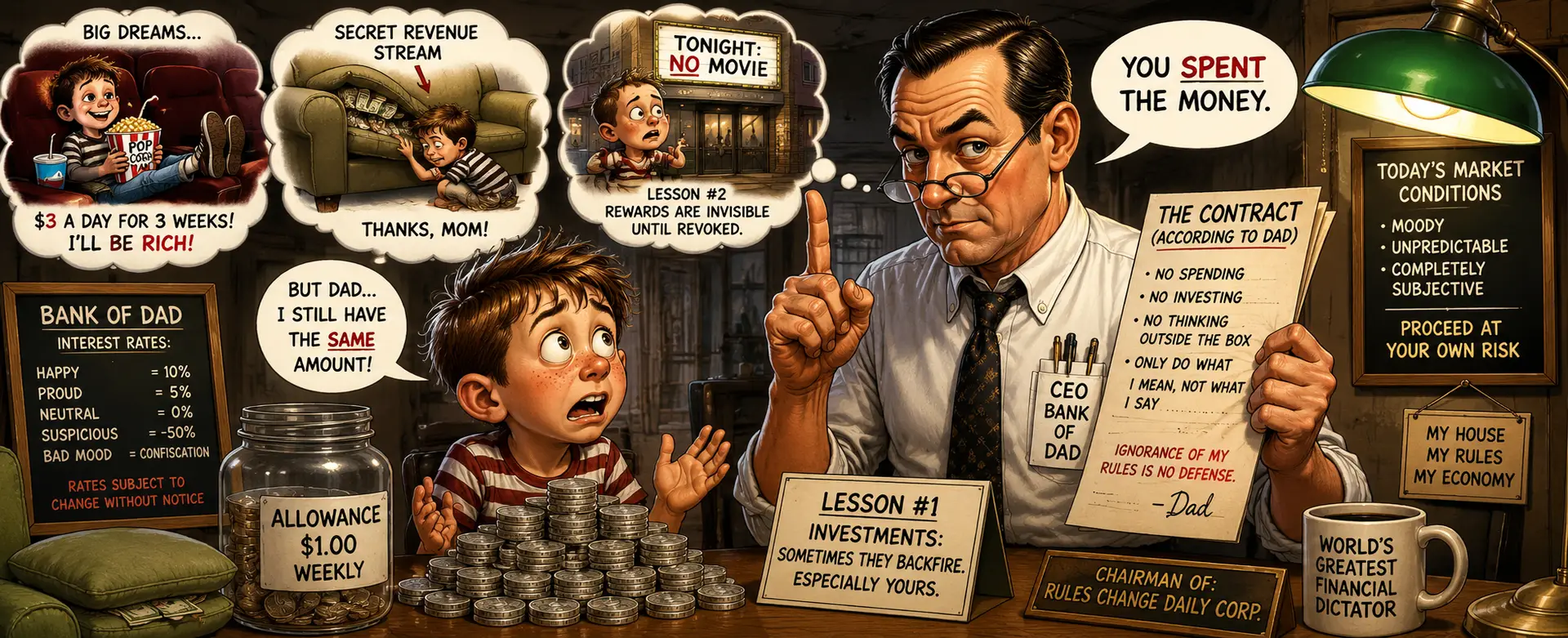
Dad said, “I’m going to give you three dollars a day.”
I nearly fainted.
“Three dollars a day once a week?” I asked.
“No,” he said. “Three dollars a day for three weeks.”
At that moment, I became a wealthy man.
I began thinking like a tycoon.
Movies.
Popcorn.
Licorice.
Possibly my own horse.
Then Dad added the condition.
“You cannot spend any of it. If you still have all the money at the end, I’ll double it.”
This sounded simple.
Even I could understand it.
Do nothing.
Become rich.
This, I later learned, is also the basic dream of every investor.
A couple of weeks went by.
Dad asked, “Where’s your money?”
“I have it,” I said proudly.
I went to my bedroom, reached into my secret hiding place, and brought back a beautiful pile of silver dollars.
I had not wasted the money.
I had improved it.
Paper money was flimsy.
Silver dollars were serious.
They had weight.
They made a satisfying sound.
You could stack them, admire them, and, if necessary, defend yourself with them.
I placed them in front of my father.
He looked at the silver dollars.
Then he looked at me.
“You spent the money.”
“No, I didn’t.”
“Yes, you did.”
“I still have the same amount.”
“But you bought coins.”
“They’re money.”
“They’re an investment.”
This was the first time in my life I discovered that money could stop being money if my father was in the right mood.
According to him, I had violated the agreement.
I had been told not to spend the money.
Instead, I had converted it into silver dollars.
In the Supreme Court of Dad, this was not savings.
It was speculation.
Possibly fraud.
Maybe treason.
He said he would not double my money.
Then, to make the lesson more vivid, he mentioned that if he were in a different mood, he might confiscate all of it.
This is how my father taught finance.
Warren Buffett got compound interest.
I got a dentist with unlimited judicial authority.
I walked away poorer, wiser, and deeply suspicious of written agreements that were not actually written down.
A little later, another lesson arrived.
School was out for the summer.
I had just finished third grade, which I considered a major academic achievement.
That evening I prepared to go to the movie, as I often did.
Dad said, “You can’t go tonight.”
“Why not?”
He thought about it.
My father often thought before delivering a ruling.
This did not mean mercy was coming.
It just meant he was sharpening the blade.
“Because,” he said, “going to the movie was your reward for going to school.”
“I didn’t know I was getting a reward.”
“Exactly,” he said.
Exactly?
I was ten.
Nothing about this was exact.
He explained that life was full of rewards and penalties you did not know about until they appeared or disappeared.
This was apparently another important lesson.
To me, it sounded like the kind of thing adults said when they had just taken away a movie.
But I remembered it.
That was the annoying thing about my father.
Even when he was being unfair, he was often being unforgettable.
He did not teach by lecture.
He taught by ambush.
One minute you were a child with silver dollars.
The next minute you were standing in front of a one-man Securities Commission.
One minute you were going to a movie.
The next minute you were learning that rewards could be invisible until revoked.
Was this good parenting?
I have no idea.
But it was memorable parenting.
And maybe that was his point.
Life does not always explain the rules in advance.
Sometimes you think you saved your money, and someone tells you that you spent it.
Sometimes you think you earned a reward, and someone tells you the reward expired when school ended.
Sometimes you think the contract is obvious, and then a dentist in a small town turns into a Wall Street lawyer with a drill.
Over the years, I met bankers, brokers, lawyers, agents, producers, landlords, tenants, and several people who could explain with a straight face why I owed them money.
None of them surprised me as much as my father.
He had prepared me.
Not kindly.
Not gently.
Not always fairly.
But thoroughly.
He taught me that money changes shape.
Rules shift.
Rewards vanish.
And if someone offers to double your money, get the agreement in writing.
Preferably notarized.
And never, under any circumstances, convert the cash into silver dollars unless your lawyer is present.
My father called it a lesson.
I called it robbery.
History may never decide between us.
But I still remember the sound of those silver dollars.
And I still remember his voice.
“Think it through.”
That was his advice.
Irritating.
Unfair.
Often delivered too late to be useful.
But, like those silver dollars, it has held its value.
