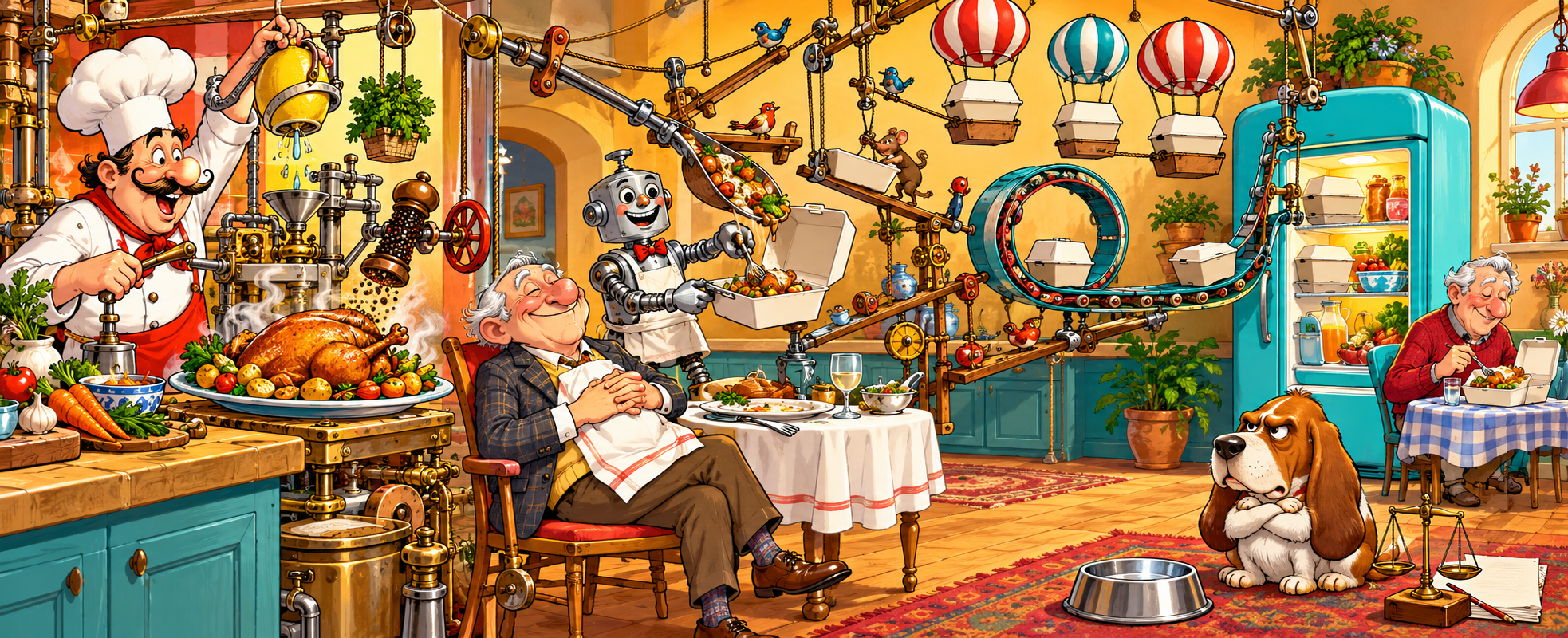

Anyone with a fistful of cash can buy some of the finest ingredients in the world.
Purchase a magnificent steak, vegetables raised by people who speak affectionately to their soil, and olive oil whose family tree goes back further than yours.
You now possess an expensive collection of groceries.
Whether you possess dinner remains to be seen.
I could buy every word Shakespeare ever used. That would not make me Shakespeare. Although, given enough wine, I might begin addressing the refrigerator as “thou.”
The genius lies in the arrangement.
A great cook understands that lemon can wake up a sleepy sauce. Salt can persuade a tomato to tell the truth. A little sweetness can negotiate a ceasefire with bitterness. Something crunchy can rescue a plate of delicious food from feeling like it has already been chewed.
Then there is heat.
In the right hands, heat transforms ingredients. In mine, it occasionally summons the fire department.
But the greatest cooks also understand restraint. They know when the dish is finished. They don’t keep adding ingredients simply because there is room in the saucepan.
This is difficult for amateurs. Once we have bought seventeen spices, we feel morally obligated to introduce all of them to the chicken.
The result tastes like an argument in an airport.
A master gives each ingredient a purpose. One takes the lead. Others support it. Nobody needs to shout.
Then comes a higher level of kitchen wizardry: creating a meal so delicious, so satisfying, that a person can lean back and say:
“That was wonderful. I’ve had enough.”
Notice the second sentence.
It is considerably harder than the first.
I would like to believe there is a culinary genius who can make food so perfect that our bodies stop us precisely when we have received adequate nourishment.
An internal accountant would announce:
“Protein received. Energy sufficient. Nutritional accounts broadly in order. Put down the fork.”
Unfortunately, deliciousness is no guarantee of moderation.
Sometimes the body says, “We’re full,” and the mouth replies, “We haven’t consulted the dessert menu.”
Nor does the stomach conduct a complete nutritional audit. It cannot certify that your vitamin requirements have been met merely because your belt has requested legal representation.
A thoughtful cook can help. A sustaining meal, satisfying flavors, and enough time to enjoy them can make it easier to notice when we have had enough.
But even the finest chef cannot prevent someone from saying, “I couldn’t possibly eat another bite,” while signaling the waiter to bring a spoon.
Which brings me to one of civilization’s most underrated inventions.
The doggie bag.
Here is a device that allows us to stop eating without surrendering the food.
We can be comfortably full and still possess tomorrow’s happiness.
That magnificent chicken does not have to disappear into us tonight. It can make a second appearance at lunch, when we are wearing less restrictive trousers.
The remarkable thing is that plenty of people requesting doggie bags don’t even have a dog.
I don’t know what percentage. Apparently, nobody checks.
The waiter never says, “Certainly, sir. Before I package the lamb, may I see a photograph of your Labrador?”
We have created an entire restaurant ritual around an animal that may not exist.
“For the dog,” we say, handing over the remains of a beautiful dinner.
An imaginary dog with sophisticated tastes, apparently. One who enjoys a mushroom reduction but prefers the sauce packed separately.
At home, the alleged dog’s dinner goes into the refrigerator. The next afternoon, we eat it ourselves.
The dog gets nothing.
Even households with an actual dog sometimes operate this fraud. The animal watches its owner consume the leftovers and must wonder why it has been named as the beneficiary of an estate it never receives.
Naturally, I became curious about how much restaurants spend packaging these little acts of deception.
I couldn’t find a reliable national figure specifically for leftover containers, so I performed a calculation using the respected scientific method of making some assumptions on a napkin.
Suppose American restaurants hand out ten million leftover containers a day. Suppose each costs fifty cents.
That would be five million dollars a day, or about $1.8 billion a year.
Those are guesses, not measured statistics. If someone quotes me in Congress, I would appreciate being identified as “a man with a napkin.”
Nevertheless, it is a splendid thought: nearly two billion dollars a year, under my imaginary accounting system, boxing up dinner for dogs that don’t exist.
And perhaps those humble containers deserve more respect.
They let us save food, stretch the value of a meal, and stop treating the last six bites as an emergency.
We can tell our appetite: “Relax. Nobody is confiscating the chicken. You can see it again tomorrow.”
There is a lesson here that reaches beyond dinner.
We often behave as though enjoying something obligates us to consume all of it immediately. We fear that stopping means losing.
But pleasure can survive an intermission.
The great chef creates a meal worth remembering. The sensible diner knows when to put down the fork. The little cardboard box reconciles the two.
Dinner gets an encore.
We get lunch.
And somewhere, a dog is looking into hiring an attorney. And you, my dear reader, may wonder where you can read more about the secrets of a perfect meal.

My pick for what you want is Salt, Fat, Acid, Heat: Mastering the Elements of Good Cooking by Samin Nosrat.
It explains why food tastes good, so you can make better decisions rather than simply follow recipes. Its four foundations are:
- Salt: brings flavors into focus.
- Fat: carries flavor and creates texture.
- Acid: balances richness and brightens a dish.
- Heat: transforms ingredients and controls texture. Google Books
That directly addresses your question: how does a gifted cook turn excellent ingredients into something greater than their individual parts? The book teaches those fundamentals in an approachable, illustrated format. published by Canongate Books.
One distinction: it teaches delicious cooking; it doesn’t promise that deliciousness will make people stop when adequately nourished. That part of our post is an appealing aspiration, not a culinary guarantee.
There is a dynamite series about SALT FAT ACID HEAT on Netflix https://www.netflix.com/title/80198288 that features the life of of Stacey Offman.
Read her book. I’d buy the print edition, so you can browse it and keep it beside you while cooking. You can find purchase options on the official book page.
Her book may improve dinner considerably. The dog will still need an attorney.
