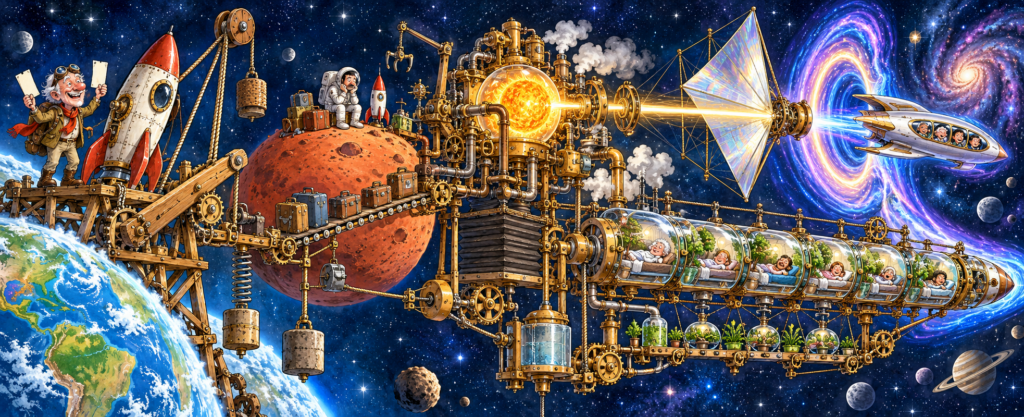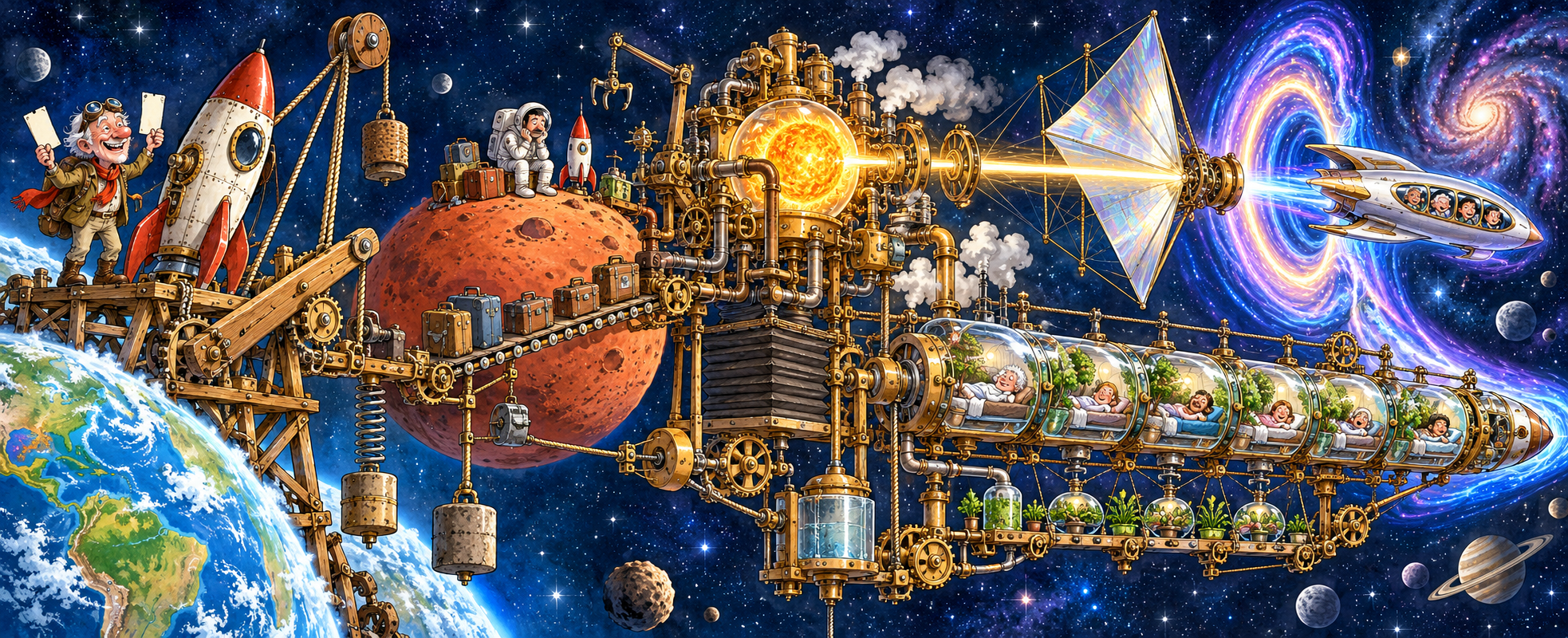

How do people on Earth manage to get to other galaxies?
They don’t.
Except in their minds, or by hitching a lift on the latest Star Trek, where somebody says, “Warp nine,” and the captain arrives in another star system before his coffee gets cold.
Meanwhile, here on Earth, I sometimes need three passwords and a verification code to get into my own bank account.
We have sent robots to Mars. Getting people there, keeping them alive, and bringing them home is a considerably larger undertaking.
I believe the problem is marketing.
NASA or Elon Musk ought to sell return tickets for an extra million dollars.
There would be only one caveat: you must stay on the red planet for a year.
This would reassure nervous passengers. Nothing says “We expect you to survive” quite like charging for the return flight.
Unfortunately, the planets have their own timetable. Some NASA mission studies allow roughly 300 to 500 days at Mars while Earth and Mars move into favorable positions for an economical journey home. My one-year minimum might therefore become sixteen months. Small print. Every travel company has it.
“Your departure has been delayed.”
“How long?”
“Until the solar system rearranges itself.”
But Mars is practically next door compared with another star.
And another star is practically next door compared with another galaxy.
Our Sun is one star in the Milky Way. Visiting another star system means traveling within our enormous galactic neighborhood. Visiting Andromeda, another major galaxy, means crossing about 2.5 million light-years. Its light takes that long to reach us.
You would want to cancel the newspaper.
Nevertheless, humans have devised an impressive assortment of ways we might someday travel farther.
First, build a better engine.
Chemical rockets got us to the Moon. Electric propulsion can use propellant efficiently, and nuclear reactors could provide energy for more capable spacecraft. These approaches are serious engineering, but none gives us a passenger service between stars. NASA studies much more ambitious possibilities, including fusion and antimatter propulsion.
Fusion would harness the kind of reaction that powers the Sun.
A splendid idea. Put a little sunshine in the engine room and try to avoid becoming part of it.
Antimatter offers another powerful possibility: when it meets ordinary matter, energy is released. Unfortunately, making, storing, and controlling useful quantities presents enormous difficulties.
You thought the airline was particular about spare lithium batteries.
Second, explode your way there.
Nuclear-pulse proposals imagine propelling a spacecraft with repeated nuclear explosions behind it.
This is the sort of idea that makes backing out of your driveway an international incident.
Other nuclear concepts use controlled pulses of fission and fusion rather than a conventional rocket flame. These remain proposed technologies, not engines you can book for your summer holiday.
Third, hoist a sail.
Light carries momentum. A reflective sail can receive a gentle push from sunlight; powerful lasers could push a very lightweight spacecraft much harder.
Breakthrough Starshot proposes tiny robotic probes traveling at about one-fifth the speed of light, potentially reaching the Alpha Centauri system in a little over twenty years. It is a research concept, with major engineering obstacles, and the proposed trip is a flyby.
Tiny probes.
No passengers. No buffet. No overhead compartment.
And passing a destination at tremendous speed introduces a question travel brochures tend to overlook:
How do you stop?
Fourth, scoop up fuel along the way.
The proposed Bussard ramjet would gather interstellar hydrogen and use it for fusion propulsion. NASA includes it among speculative propulsion concepts.
Think of a car that collects gasoline through its grille.
Unfortunately, space is exceptionally stingy about supplying fuel, and collecting it introduces its own problems.
Even the universe doesn’t want to pay for your vacation.
Fifth, make the passengers last longer.
A generation ship would carry a community whose descendants eventually reach the destination.
You board in Los Angeles. Your distant descendants disembark beneath another sun.
Somewhere along the way, a teenager asks, “Are we there yet?”
Civilization collapses.
Another proposal is suspended animation: put everyone into a prolonged sleep and wake them near the destination. We cannot currently freeze people for centuries and reliably revive them.
I do, however, know several committee meetings that could provide preliminary training.
Sixth, let Einstein shorten the journey.
At speeds close to light speed, less time can pass for travelers than for people remaining on Earth.
That is real physics. The trouble is accelerating a substantial spacecraft to those speeds, protecting it from radiation and collisions, and slowing it down again.
You might return younger than your great-grandchildren.
Explaining this at Thanksgiving would require diagrams.
Seventh, take a shortcut through space itself.
Warp drives imagine changing spacetime around a spacecraft. Wormholes imagine connections between otherwise distant regions.
There are mathematical models behind these discussions, but a mathematical model is not a working engine. Wormholes remain highly speculative; NASA describes warp drive as fantasy with our present capabilities.
My household budget also contains several mathematically attractive shortcuts. None has produced a yacht.
Finally, we could send robots—or imagine sending digital versions of ourselves.
Robots already explore places humans cannot safely visit. Uploading a human mind, however, remains speculative. We do not know how to do it, or whether the resulting traveler would be you or merely something convinced it was you.
Mine would immediately complain about the accommodation.
For now, imagination remains our most reliable intergalactic transportation system.
No fuel bill. No radiation sickness. No checked-baggage fee.
But I still support selling that million-dollar return ticket from Mars.
Before paying, I would ask one question:
“Is the return spacecraft already there?”
If the answer is, “We’re working on it,” I shall admire the red planet from my balcony.