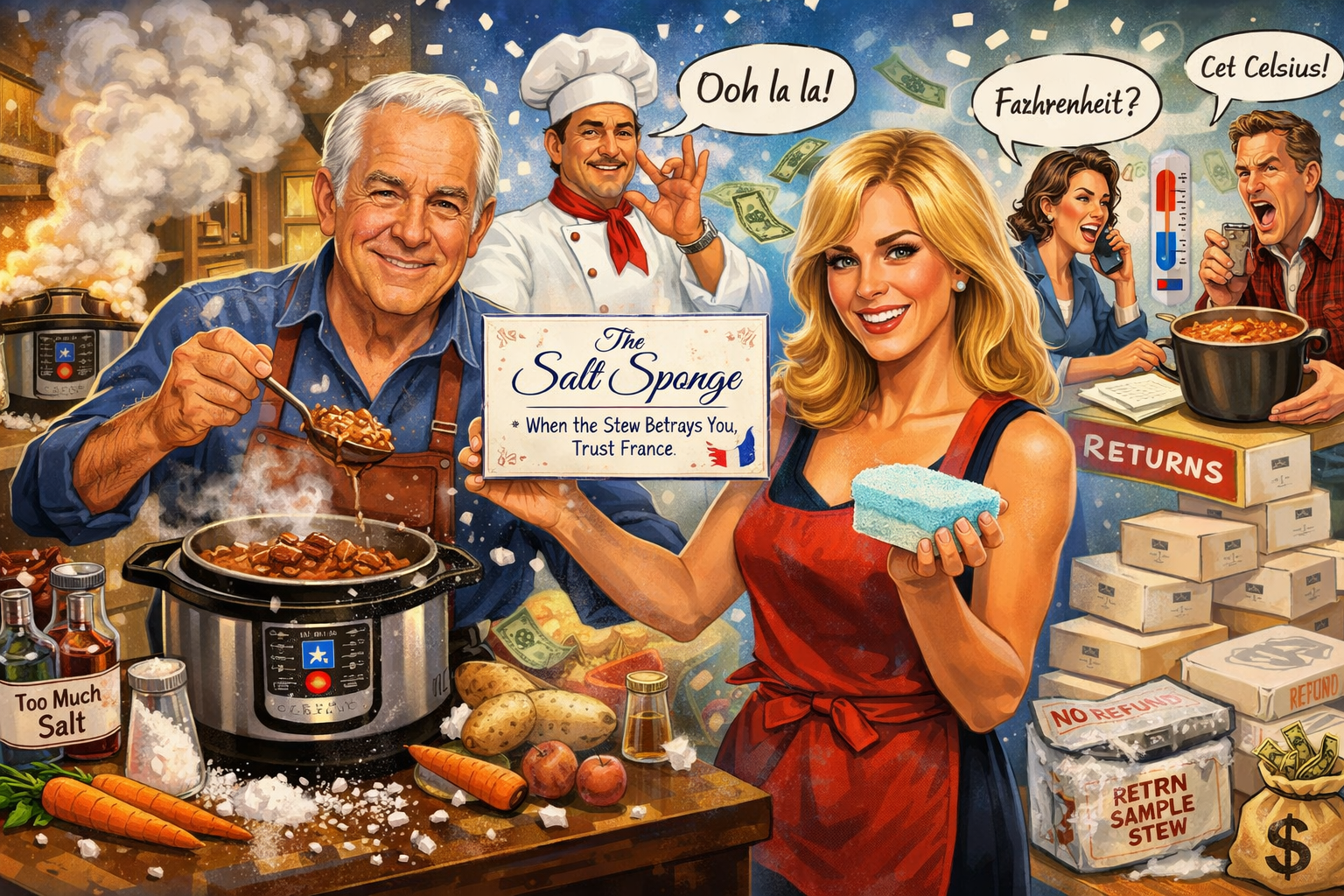

Oversalted beef bourguignon leds to a French endorsement and a business built on temperature confusion.
Lately the world seems to be in a foul mood.
Every time you turn on the news, somebody is bombing somebody, two governments are threatening a third government, the economy is making the sort of noises a transmission makes just before it falls out onto the freeway, and ordinary people like Kate and me are left in the grocery store staring at a roast as if it were a trust fund.
Kate and I are careful with money.
We always have been.
We do not throw it around like drunken emperors.
If we buy beef, there has been discussion.
There may have been maps.
One of Kate’s favorite things to make is beef bourguignon, which is really beef stew with a French passport and better public relations.
Some time ago we had it at a restaurant.
It arrived frozen.
That should have been our first clue.
French food should present itself steaming gently on a plate, not with the emotional warmth of a coroner’s drawer.
We took it home, thawed it out, and ate it anyway because that is what decent middle-class people do once they have already paid.
It was so oversalted I began to suspect the chef had a personal grudge against kidneys.
It was awful.
So naturally we decided to make it ourselves.
We bought good meat.
We already had potatoes.
We borrowed carrots from the neighbors, which gave the whole enterprise a Depression-era air of thrift, sacrifice, and root-vegetable diplomacy.
Kate cut the beef against the grain, salted it, seared it, and loaded it into the Instant Pot with broth, herbs, vegetables, and what I privately suspected was enough additional salt to embalm a Civil War general and two of his horses.
I said nothing.
This is one of the small sacrifices that makes marriage possible.
The stew cooked for an hour and a half, followed by thirty minutes of what the Instant Pot calls “natural release,” which I take to mean standing in the kitchen while the machine decides whether dinner is ready or the lid is about to enter low Earth orbit.
At last we opened it.
We tasted it.
It was catastrophic.
Not mildly salty.
Not a touch assertive.
Not robust.
This was the kind of saltiness that makes your tongue feel it has been notarized.
One spoonful and I could feel my blood pressure trying to retain counsel.
Kate, who is practical in a crisis, suggested thickening it.
Add flour.
Add carrots.
Add more vegetables.
Add anything, really, short of a priest.
We did all of that.
Nothing helped.
The stew remained so salty that if the ocean had tasted it, the ocean would have said, “Easy.”
That was when genius struck.
Millions of people cook at home.
Millions of them oversalt soup, stew, chili, gravy, casseroles, and no doubt the occasional birthday cake.
Somewhere in America tonight a husband is pretending to enjoy a pot roast out of fear.
Somewhere else a wife is smiling bravely through a chili that could preserve fence posts, deck furniture, and perhaps a sheriff.
The need was obvious.
What the world needed, I thought, was The Salt Sponge.
The concept was elegant.
If your stew is too salty, you simply dip the Salt Sponge into it, let it absorb the excess salt, remove it, rinse it out, and repeat as needed.
Dinner is saved.
Waste is prevented.
Domestic peace is restored.
Nobel committees make discreet inquiries.
I tested the theory with an actual sponge.
It did not remove the salt.
What it removed was liquid.
So instead of fixing the problem, it reduced the amount of stew while making the surviving stew even saltier.
In scientific circles, this is sometimes referred to as “the opposite of progress.”
At this point a lesser man might have abandoned the whole thing.
I did not.
I realized the flaw was not in the product.
The flaw was in my thinking.
I was still trapped in the old-fashioned notion that a product should work.
That is not how greatness is built.
Greatness is built on confidence, packaging, strategic ambiguity, and at least one French chef willing to endorse it for a slice of the profits.
As luck would have it, I know Chef RR Gonzales, who is French enough for our purposes and, more important, unavailable for immediate fact-checking.
Kate looked at me in that calm way wives do when they sense a man has confused failure with opportunity.
Here was the plan.
We package the Salt Sponge in an elegant cream-colored box with gold script, perhaps a crest, perhaps a drawing of a saucepan in emotional distress.
We market it as a premium culinary rescue device for soups, sauces, and bourguignon-related emergencies.
We create a slogan:
When the stew betrays you, trust France.
Then we include the instructions.
⊕ Before first use, soak the Salt Sponge in water heated to 70 degrees for exactly 17 minutes.
⊕ Rinse thoroughly.
⊕ Then place it in the stew.
⊕ Salt is reduced by 37 percent with each application.
People adore this kind of thing.
The more precise the nonsense, the more scientific it sounds.
Of course it still would not work.
The customer would dip it in.
The sponge would fail completely.
The stew would become smaller and saltier.
They would call us in a rage.
And that is when customer service would take over.
Very politely, we would ask, “Did you follow the instructions exactly?”
They would say yes.
We would ask, “And you heated the water to 70 degrees?”
Again they would say yes.
Then we would deliver the coup de grâce.
“Madam,” I would say, with European sadness, “this product was developed for beef bourguignon. A French dish. The instructions are metric. That is 70 degrees Celsius.”
At that point the customer begins to suspect the problem may be international.
That gets us through America.
In France, naturally, we reverse the fraud.
There we print 39 degrees and say nothing.
They assume Celsius.
If they complain, we explain with grave regret that the instructions were in Fahrenheit and intended for North America.
This, I believe, is what global business leaders call scalability.
There remained the problem of returns, but I had thought of that as well.
Any customer seeking a refund must return the Salt Sponge along with a sample of the failed stew for laboratory analysis.
Overnight shipping only.
Proper refrigeration required.
By the time they pack and mail the evidence, they will have spent more defending the stew than the stew itself.
And if they ask whether they can buy another Salt Sponge, we decline.
We are not monsters.
But after being sold frozen French food by strangers and then ruining our own homemade batch with enough salt to preserve a moose, I have come to believe that the modern economy leaves ordinary citizens only two choices:
learn the metric system
or monetize disappointment.
There appears to be some crossover in the grievance industry, because angry customers who call the Salt Sponge number often reach the same man who once sold us frozen beef bourguignon.
Which, if nothing else, restores my faith in karma, French cuisine, and the modern marketplace.