
Concrete Evidence
I have known two men who claimed they could manufacture stone.
One may have solved the mystery of the pyramids.
The other went to jail.
This does not necessarily mean the first man was right. It simply means he had a better lawyer—or the Egyptian statute of limitations had expired.
I met the first man when I was twenty-two.
I had recently completed a two-year Mormon mission in New Zealand and was returning to North America by wandering through countries where I knew nobody, understood nothing and possessed the survival instincts of a buttered dinner roll.
Youth protected me.
So did stupidity. Sometimes it is difficult to tell them apart.
In the Hong Kong Hilton, I met a fat man who looked remarkably like John Candy. He said he was the governor of the Gaza Strip.
Naturally, I believed him.
Today, if a stranger in a hotel bar told me he governed Gaza, I would ask to see identification, three references and an independently audited election.
At twenty-two, I finished my Coke and accepted his friendship.
The governor somehow learned my travel plans and arranged for an assistant to meet me when my Pan Am flight reached Cairo.
The assistant was a small, greasy man who escorted me to an excellent hotel and announced that the governor would pay for everything.
This seemed perfectly reasonable.
Apparently, foreign governments were eager to subsidize young Mormon writers returning from New Zealand. It was an enlightened period in international relations.
The governor was busy and would see me in a few days. Meanwhile, I was instructed to enjoy Cairo.
I did.
I boarded an open-windowed streetcar and travelled to the edge of the city. From there I walked into the desert, where I found the Sphinx and the pyramids conveniently waiting for me.
At the Great Pyramid, I hired a diminutive guide for approximately a nickel.
Feeling wealthy and generous, I handed him a dollar.
His eyes widened.
Only after entering the pyramid did I realize I may have shown him more money than he could earn in a very long time.
No one knew where I was.
No one knew who he was.
And behind me, in the darkness, something metallic scraped against the ancient stone.
It was his knife.
Or, more accurately, it was a knife in a scabbard.
There is an important distinction. A knife in a scabbard is not necessarily dangerous. But when you are crawling through a dark pyramid with a stranger who has just seen your wallet, it becomes a complete theatrical production.
Ahead, I saw a faint light.
I scrambled toward it and entered a chamber where three men sat around an oil lamp.
One was sharpening a knife.
Possibly he was preparing lunch.
Possibly I was lunch.
My guide climbed into the chamber behind me. I turned, seized him and flung him across the room.
He landed among the other men.
The oil lamp shattered.
Robes caught fire.
Turbans caught fire.
The chamber erupted in shouting, cursing and a spirited demonstration of ancient Egyptian firefighting techniques.
I escaped down the passage, sprinted across the desert and reached Cairo in a time that would have qualified me for several Olympic events.
To this day, I do not know whether I escaped from four murderers or assaulted the most hospitable tour guides in Egypt.
Somewhere in Cairo, a family may still tell the story of the insane Canadian who tipped extravagantly, set everyone on fire and left without completing his tour.
That was not, however, the end of my pyramid education.
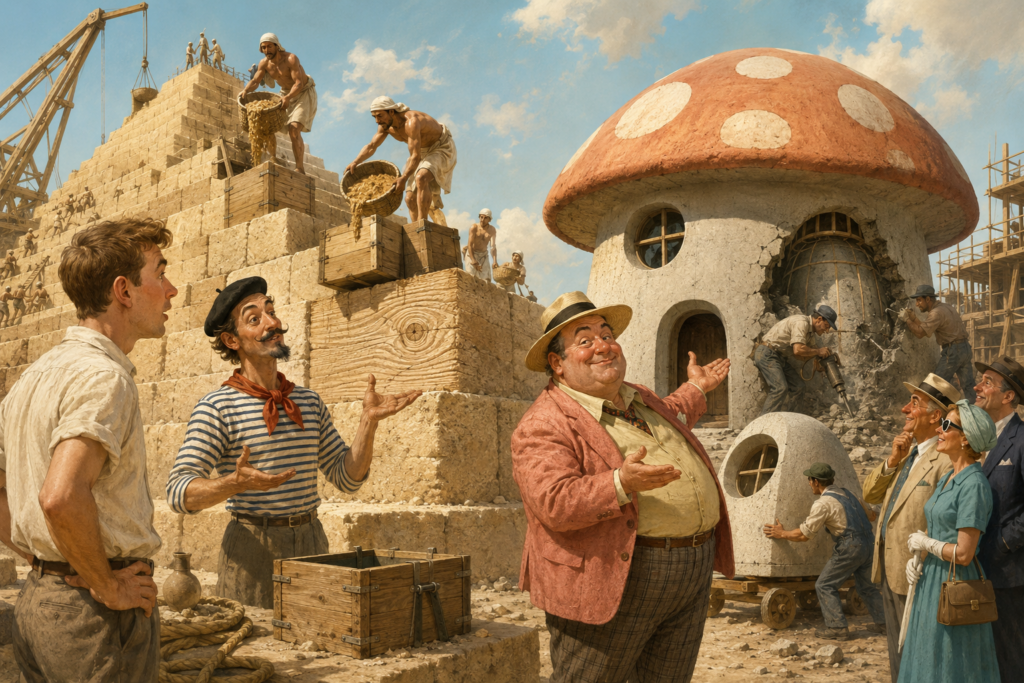
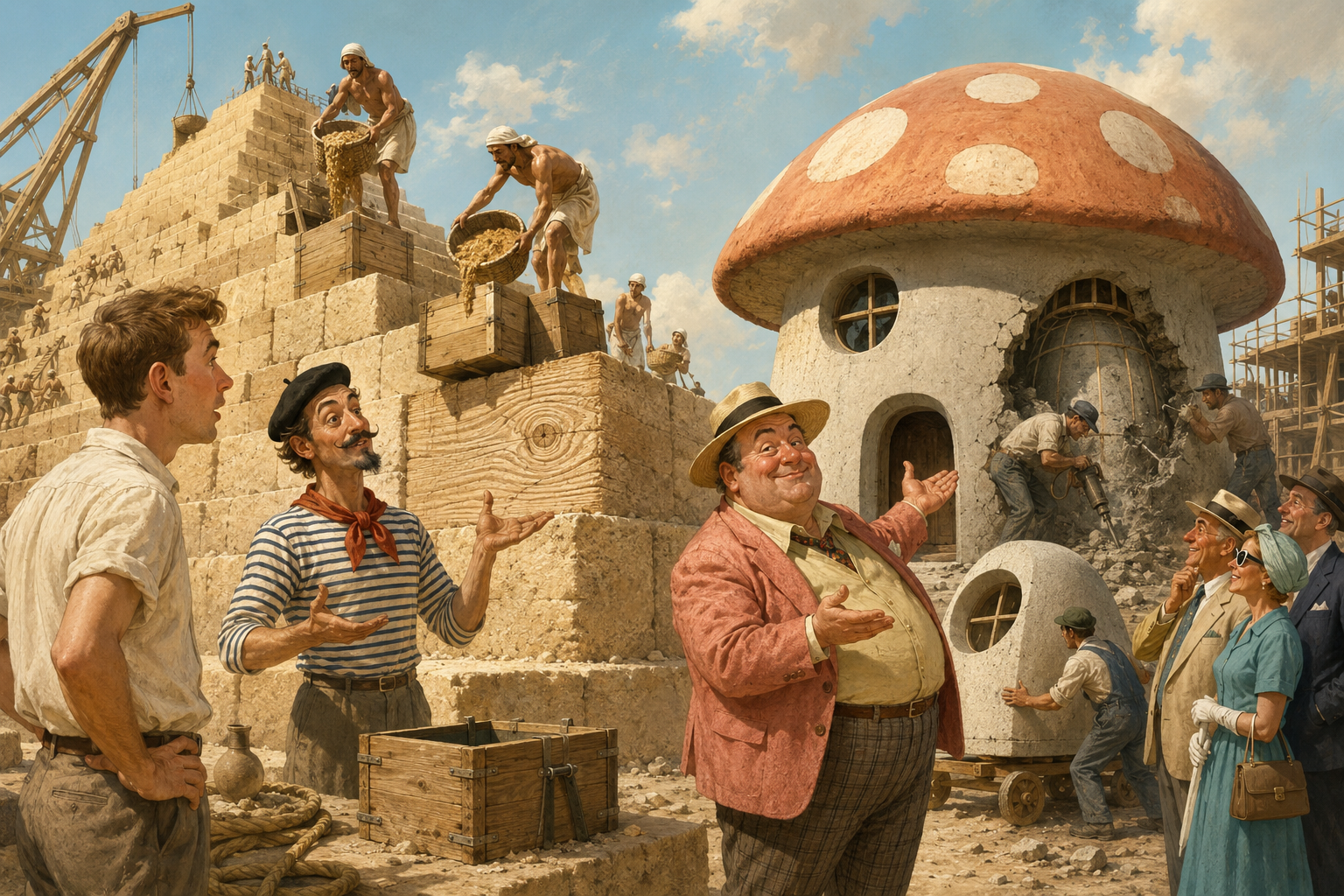
I later met a Frenchman who had a theory about how the pyramids were built.
He showed me perhaps a dozen blocks that he claimed were thousands of years old. Some appeared to retain the exact grain of the wooden boards that had once surrounded them.
His explanation was wonderfully simple.
The Egyptians had not quarried millions of enormous stones and dragged them up gigantic ramps. They had carried sand, crumbled limestone and a binding agent upward in manageable loads.
Then they built wooden forms and manufactured each block exactly where it was needed.
Build one level.
Pour the next.
Continue for twenty years, or until the Pharaoh changes his mind.
The theory made sense to me. It was much easier to imagine hundreds of men carrying baskets than dragging stones weighing several tons up a ramp reaching halfway to Syria.
The Frenchman may have been a genius.
He may have been a lunatic.
In my experience, the distinction is usually settled by whether the invention works before the investors run out of money.
About eight years later, when I was thirty, I met another visionary who promised to revolutionize construction.
He was clever, charming and exceptionally persuasive.
In other words, he was a con man.
He claimed he could build concrete houses for approximately $700.
The houses were about 700 square feet and shaped like giant mushrooms.
This gave a family shelter for one dollar per square foot, provided the family did not object to living inside something that looked as though it had sprouted overnight after heavy rain.
His secret was the form.
A reusable mould would be placed on the building site. Concrete would be poured around it. Once the concrete hardened, the form would be removed and used again.
According to him, each form could build one hundred houses.
The economics were irresistible.
Buy one form.
Pour one hundred mushrooms.
Retire as the wealthiest toadstool manufacturer in North America.
Investors gave him millions.
There was only one problem.
The form did not survive the first house.
It ruptured and became trapped inside the hardened concrete. Workers then had to remove it with jackhammers, which is generally not what manufacturers mean when they describe a product as “reusable.”
This should have ended the enterprise.
Instead, it inspired the con.
After the ruined original had been laboriously chipped out, a second form was placed inside the completed house.
Prospective investors were then invited to the site.
They arrived just as cheerful workmen were removing the second, perfectly intact form.
The investors saw a finished concrete house and a reusable mould sliding gracefully out of it.
They assumed the form had produced the house.
In reality, it had spent the afternoon sitting inside the house, enjoying the same structural responsibilities as a sofa.
The demonstration was magnificent.
The form emerged undamaged.
The investors applauded.
Their money disappeared.
Eventually, the authorities became unreasonably interested in the difference between constructing a house and placing construction equipment inside one.
The visionary went to jail.
Before that happened, however, he wanted me to marry his daughter.
Fortunately, I declined.
Otherwise, I might have acquired a wife, a mushroom-shaped home and several million dollars’ worth of questions from federal prosecutors.
Looking back, I realize that the Frenchman and the con man were selling essentially the same dream.
Why move massive objects when you can create them exactly where you want them?
The Frenchman said the idea built the pyramids.
The con man said it would build affordable homes.
One showed me ancient blocks bearing what appeared to be the grain of wooden forms.
The other showed investors a form that had never formed anything.
Perhaps the pyramids really were poured.
Perhaps every block was quarried, dragged, lifted and fitted into place by thousands of workers with ropes, sledges, ramps and considerably stronger backs than mine.
Scientists are still arguing about it.
But I learned something valuable from both men:
A wooden form can produce a building.
It can also produce a fortune.
The important question is whether the concrete was poured before or after the investors arrived.
And if anyone ever offers you a $700 mushroom house, inspect it carefully.
If you hear jackhammers inside, do not invest.
And under no circumstances marry the builder’s daughter.