The $25 Fraud: The CBC Enters the Dark Ages,
Carrying a Smartphone
The Canadian Broadcasting Corporation has announced, in the rules for its short story contest, that writers may not use artificial intelligence—not merely to write their stories, which would be understandable, but even to brainstorm them.
Apparently, a writer who asks a computer, “What occupations might a lonely man have?” has committed an offence against literature. If the machine answers “lighthouse keeper,” the writer must immediately abandon lighthouses, loneliness, electricity and possibly the sea.
This is not a defence of pressing a button and submitting whatever tumbles out. A literary contest should reward writers, not appliances. If I ask artificial intelligence to produce two thousand words about a widowed beekeeper in Moose Jaw, then enter those words under my name, I have not written a story. I have ordered one. That distinction is simple, defensible and perfectly capable of being expressed in a contest rule.
But the CBC has wandered considerably farther. It has attempted to prohibit a mental conversation. Brainstorming is not authorship. It is the untidy process by which authors annoy spouses, interrogate friends, eavesdrop in restaurants, read newspapers, consult dictionaries, stare into refrigerators and ask bartenders whether a body could be concealed in a beer keg.
Writers have always borrowed friction from the world around them. The spark may come from an overheard sentence, a childhood humiliation, an editor’s objection or a taxi driver who says, “You want a story? I’ll tell you a story.” The resulting work belongs to the writer who transforms that material into something singular.
Under the CBC’s theory, however, some sources of friction are morally pure and one is contaminated. You may brainstorm with a professor, a criminal lawyer or your cousin Leonard, who has been wrong about virtually everything since 1973. You may consult twenty books written by strangers. You may watch documentaries assembled by hundreds of technicians. You may search the Internet, where billions of people have deposited every fact, fantasy and photograph they possess.
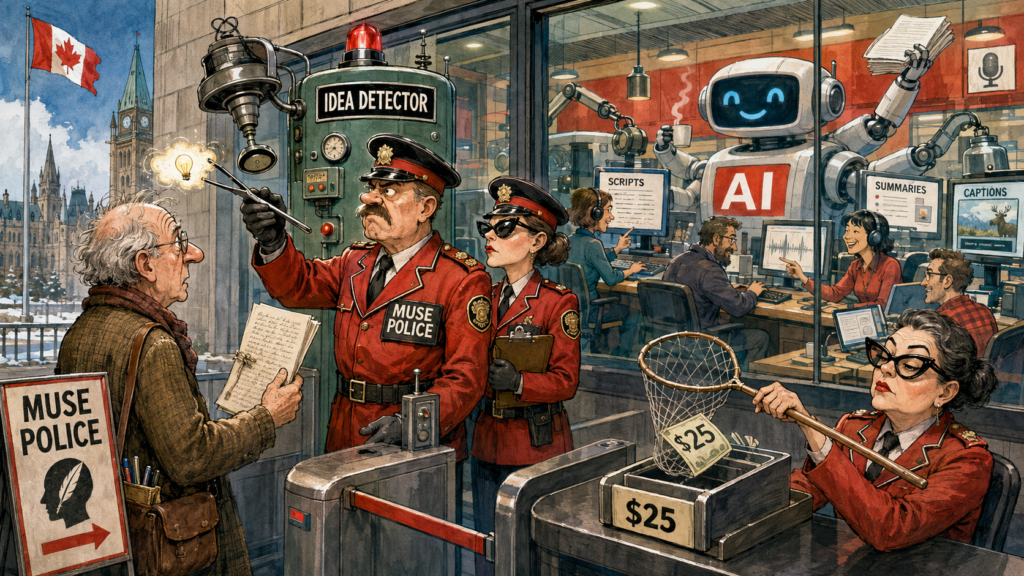
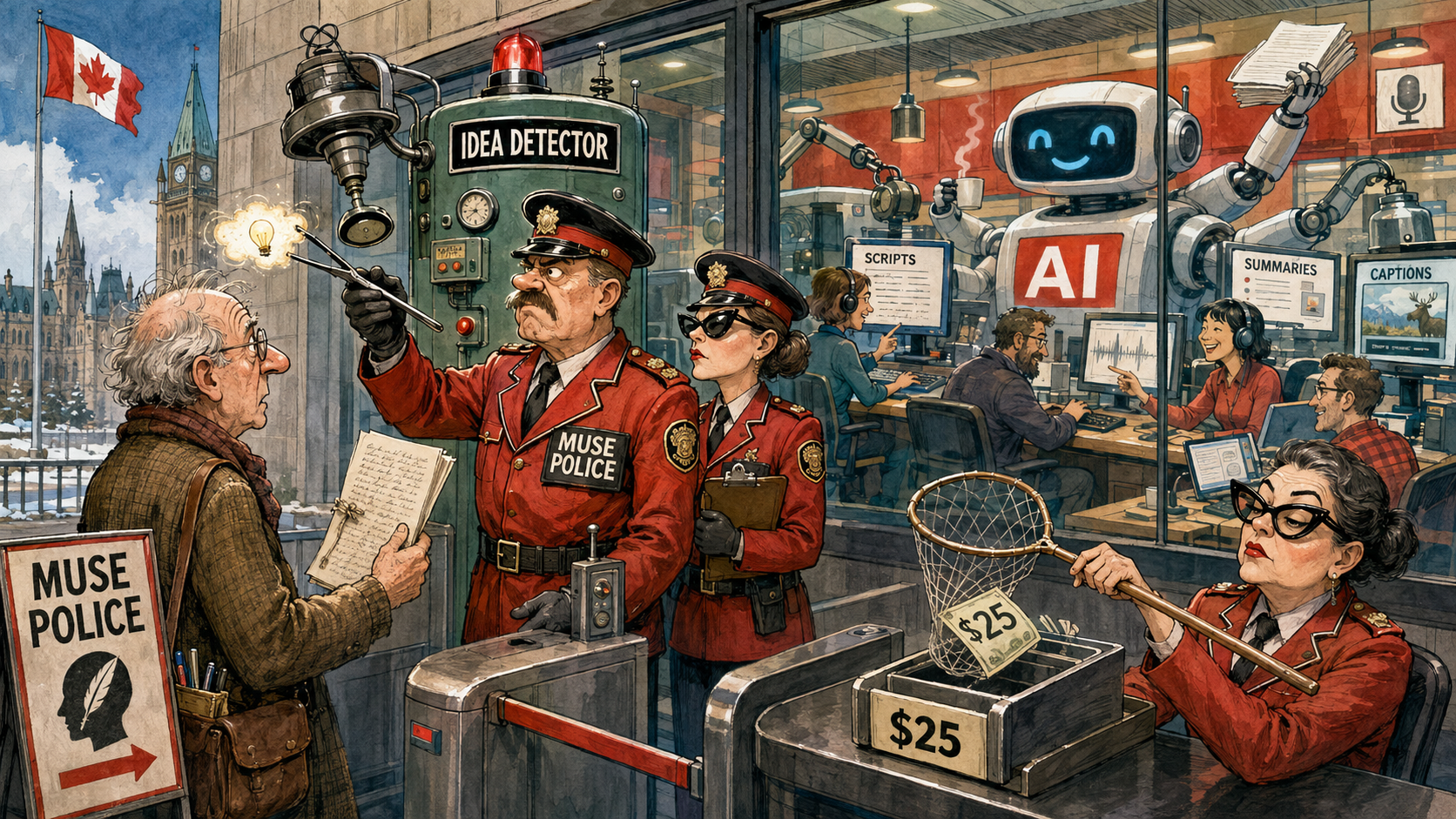
But ask an artificial intelligence to list five reasons a bride might flee her wedding, and the Muse Police arrive with a warrant.
The comedy becomes richer because the CBC is not preserved in amber. Like almost every modern media organization, it inhabits a world saturated with algorithms.
Its employees use digital search, automated transcription, spelling and grammar tools, recommendation systems, data analysis and, very likely, generative AI for perfectly ordinary workplace tasks. Perhaps someone at the CBC used AI to help summarize a meeting at which everyone agreed that writers must never use AI to help summarize anything.
This does not make the CBC wicked. It makes the CBC contemporary. Artificial intelligence has arrived in offices with the quiet inevitability of email, except email never offered to rewrite your apology before you sent it. Institutions are experimenting.
Some uses are intelligent, some lazy, and some produce prose with the nutritional value of a packing peanut. But it is peculiar for an organization to benefit from a technology while treating writers who merely converse with it as if they had smuggled a ghostwriter into the basement.
The difficulty is that “brainstorming” has no sensible boundary. Suppose I ask AI when passenger trains crossed Saskatchewan in 1910. Is that research or brainstorming? Suppose I ask for ten surnames common in Winnipeg’s Icelandic community. Research again?
Suppose one surname reminds me of a teacher who frightened me in grade six, and I create a character unlike anything the machine suggested. Has the story now been touched by forbidden electricity?
What if I type a paragraph into a grammar checker that now contains hidden AI features? What if Microsoft Word suggests a clearer phrase? What if Google completes my search question before I finish typing it? What if my telephone transcribes my voice and silently corrects “Riel” to “real”? Must I disclose that Louis became an adjective for three seconds?
A rule that cannot define its own border does not protect integrity; it manufactures anxiety. Honest writers will worry about accidental violations, while dishonest writers will simply lie.
The conscientious entrant will wonder whether asking ChatGPT for the population of Regina constitutes creative assistance. The determined cheat will generate an entire story, revise a few commas and swear upon a first edition of Alice Munro that every syllable arrived by candlelight.
Enforcement is even more absurd. Reliable detection of AI-written prose remains elusive, particularly after human revision. Detection programs can mistake patterned, formal or second-language writing for machine output. They can also miss heavily edited machine prose. A celebrated stylist might be accused because she likes balanced sentences. A mediocre robot might escape because its operator instructed it to add typos and resentment.
The CBC would therefore be policing an invisible act using evidence that cannot reliably prove it occurred. Did the writer brainstorm with a machine? There is no watermark on an idea.
“A lighthouse keeper discovers a body” does not arrive bearing a label that says INSPIRED BY CHATGPT AT 4:17 P.M. The CBC must rely on honour, which is reasonable, but honour works best when the rule itself is reasonable. Otherwise it rewards entrants who interpret language aggressively and punishes those who confess that a chatbot once suggested naming the dog Harold.
There is also something dispiriting about treating writers as fragile creatures whose imaginations must be quarantined. A capable writer is not overpowered by a list of suggestions. Writers reject advice professionally.
Give ten novelists the same premise and they will produce eleven stories, because one of them will change his mind halfway through. The artistry lies in selection, structure, language, rhythm, perception and the thousand private judgments that convert possibility into prose.
I have written for most of my life. I have received ideas from producers, editors, actors, strangers, dreams, accidents and people who later insisted the best part was theirs. No one has ever suggested that receiving an idea erased the labour of writing. On the contrary, professional writing is often collaborative.
A producer asks, “What if she is his sister?” An editor says the ending begins on page seven. A spouse observes that no human being has ever spoken the sentence you are defending. The writer listens, resists, steals, transforms and finally takes responsibility.
AI does not abolish that responsibility. It increases it. A machine can produce fifty possibilities in seconds, forty-eight of them dead on arrival. The writer must recognize the two with blood in them—and then do the difficult work. Used badly, AI makes prose bland.
Used intelligently, it can function like an inexhaustible but frequently intoxicated assistant: fast, confident, occasionally brilliant and never permitted near the final decision without adult supervision.
The proper rule is obvious. The submitted text must be substantially and demonstrably the entrant’s own creative work. AI-generated stories, passages or rewrites should be prohibited. Entrants should be able to use ordinary research and accessibility tools. If the CBC wishes, it can require disclosure of significant generative assistance. Such a rule protects authorship without pretending that thought occurs in an airtight room.
Disclosure would also encourage the conversation Canadian culture actually needs. How much assistance changes authorship? Is asking for twenty plot possibilities different from asking an editor? Is machine line-editing different from Grammarly?
Does the answer depend on how much of the suggestion survives? These are difficult questions, but prohibiting even brainstorming does not answer them. It merely pulls a blanket over the future and declares the room historically authentic.
The ban is especially strange for a public broadcaster. The CBC should help Canadians examine technological change with curiosity, scepticism and intelligence. Its literary prize could model a thoughtful standard: human authorship is essential; tools must remain tools; substantial machine-generated expression is ineligible; transparency matters.
Instead, it has chosen the regulatory sophistication of a monastery banning forks because someone once committed gluttony.
One suspects the real fear is not brainstorming but contamination. Literature is imagined as a sacred woodland, and AI as a pipeline crew arriving with machinery. Yet writers have never worked in technological innocence. The pencil altered composition. The typewriter altered it again. Word processors made revision effortless. Search engines replaced afternoons in reference libraries. Digital thesauruses placed ten thousand dubious adjectives within reach of anyone reckless enough to use them. Each tool changed the process; none relieved the writer of making art.
Of course, AI is more powerful than a pencil. It can imitate tone, propose scenes and generate finished-looking pages. That power justifies caution. It does not justify intellectual panic. Cars are more powerful than shoes, but marathon organizers do not prohibit runners from using cars while planning their routes. They prohibit driving in the race.
The CBC’s rule confuses preparation with performance. It is as though a cooking competition permitted contestants to consult cookbooks, grandmothers and French chefs, but disqualified anyone who asked a refrigerator what could be made from eggs. The omelette must still be cooked. More importantly, it must still taste like something.
Perhaps the rule’s authors believe they are defending vulnerable writers from an unfair advantage. But ideas have never been distributed fairly. Some writers have university libraries, brilliant friends, patient editors and cottages overlooking lakes. Others have three children, a night shift and a kitchen table that wobbles. A free conversational tool may narrow that inequality by giving an isolated writer someone with whom to test a question. Banning that conversation does not level the field. It privileges older forms of assistance and those fortunate enough to possess them.
Nor does brainstorming guarantee excellence. Every writer knows that ideas are the inexpensive part. Execution is where ambition goes to have its organs inspected. Artificial intelligence can suggest that a retired magician discovers his late wife was a spy. Fine. Now the writer must create the magician, the wife, the marriage, the discovery, the emotional truth, the sentences and an ending that does not collapse like a folding chair. The premise is a match. The story is the fire, the house and the insurance investigation.
The CBC should revise its rule before it becomes a museum label: THIS IS HOW CULTURAL INSTITUTIONS RESPONDED WHEN THE FUTURE KNOCKED. Nobody is asking the judges to reward machine-made fiction. We are asking them to distinguish between outsourcing imagination and exercising it with modern tools nearby.
And now we arrive at the twenty-five dollars. The CBC did not merely publish a muddled opinion about artificial intelligence. It charged every entrant an admission fee. A public broadcaster collected twenty-five dollars from each hopeful writer for entry into a competition governed by a standard so sweeping that it forbids even brainstorming with AI. Yet brainstorming leaves no fingerprints. The rule cannot be reliably defined, detected or enforced. The CBC has built a tollbooth at the entrance to an honour system and is charging writers for the privilege of trusting one another.
I use the word “fraud” with comic rather than criminal intent. I am not suggesting that anyone at the CBC secretly departed the building with the entry fees concealed in a violin case.
I am suggesting something more Canadian: an institution has collected money under a rule it cannot possibly administer, while maintaining a grave expression and hoping nobody asks an impolite follow-up question.
If the CBC genuinely believes that any encounter with artificial intelligence contaminates a literary work, it has a solemn duty to investigate last year’s competition. Every entrant should receive the twenty-five-dollar fee back, with interest, an apology and perhaps a commemorative quill.
The winners must then be interrogated. Did any of them ask Google a question? Accept a suggestion from Microsoft Word? Use a grammar program containing an undisclosed algorithm? Did a spouse propose a better ending while standing near an Alexa?
Until the CBC can prove that every winning thought emerged from an entirely unassisted human brain, the prize money must be returned. This may seem cruel, but purity is purity. Rules worthy of retroactive moral certainty deserve retroactive enforcement. The winners can reapply for their money after submitting sworn affidavits from everyone with whom they discussed the weather, their childhoods or the third act.
Naturally, the winners are not really the villains. They entered the competition offered to them and presumably wrote the best stories. The absurd demand that they return their prizes is useful precisely because it reveals the absurdity of the CBC’s position. If enforcement would be ridiculous after the contest, it was no less ridiculous during it. The only difference is that, during the contest, the CBC kept everyone’s twenty-five dollars.
That money should be returned. Not because every entrant was cheated of a prize, but because entrants paid for a competition whose central purity test cannot be verified. A contest may judge prose. It may insist upon original authorship. It may reject generated passages. It cannot inspect the private ancestry of every thought and certify that no silicon was present when inspiration struck.
Human creativity does not become less human whenever it encounters a machine. It becomes less human when the person stops choosing, risking, revising and caring. Those are the acts a literary competition should protect. Police the submitted prose. Demand honesty. Punish fraud. But do not declare that asking a question is cheating.
There is delicious irony. The short story has always been a laboratory for forms. It thrives on compression, surprise and unlikely thoughts. Yet the institution celebrating imaginative risk has drawn its rule with the certainty of a customs officer confiscating a banana. It does not ask whether the tool replaced the writer’s imagination. It asks whether the writer and the tool were introduced.
This is not how culture advances. We learn instruments by touching them, misusing them, arguing about them and eventually deciding where they belong. Photography did not murder painting. Film did not murder theatre. Television did not murder reading. AI will undoubtedly produce oceans of dreadful prose, but humanity was producing prose efficiently beforehand. The answer is judgment, not superstition.
A literary prize should identify excellent human writing, not certify that its author observed an artificially reconstructed nineteenth-century writing process. Let entrants preserve drafts if provenance matters. Let them disclose tools. Let judges judge the words. And if a story is lifeless, reject it for being lifeless, whether its creator was a computer, a committee or cousin Leonard after two bottles of Canadian Club.
The CBC has spent generations bringing new voices, technologies and arguments into Canadian homes. It should not greet this one by bolting the door, lowering the blinds and warning writers not to think near an electrical outlet. The future is already inside the building. Apparently, it works there.