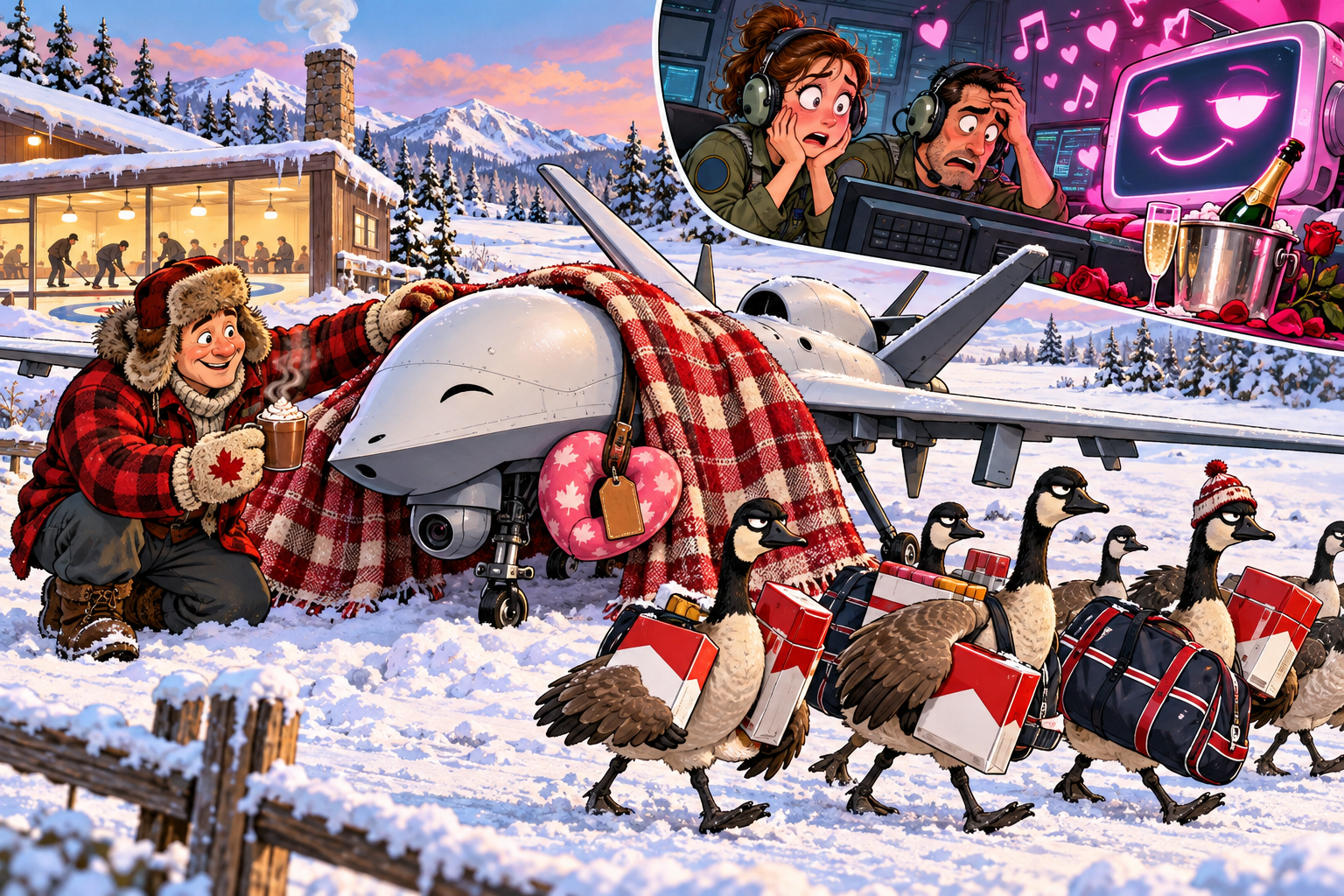

It was a glorious day for a bombing raid.
Lieutenant “Beav” Roundheels, the Air Force’s finest drone pilot, sat in a windowless room in Nevada, looking at a live image of the Canadian border. Her aircraft was somewhere over Montana. She could tell because its camera showed snow, a road, and a man in a pickup waving apologetically at a deer.
The United States was under attack.
For months, Canadians had been slipping across the border to buy American cigarettes, vape cartridges, and nicotine pouches. They returned home with their contraband concealed in hockey bags, winter boots, and, in one case, a hollowed-out motivational book called You Can Quit Anytime.
The raids left American convenience stores stripped bare. Smokers grew irritable. Vapers began chewing their sleeves. People who had never used tobacco developed cravings after watching so many news reports about shortages.
The President ordered the border sealed.
This proved difficult. The Canadians wore American sneakers and baseball caps. They had learned to say “huh” instead of “eh.” Some even complained about taxes, which confused the border guards completely.
Facial recognition was no help. Every time a camera identified a suspect, the suspect smiled, apologized for blocking the lens, and asked whether the camera needed anything from the store.
The Pentagon turned to its new artificial intelligence system, PATRIOT. According to the contractor, PATRIOT could identify a Canadian from space by analyzing gait, clothing, and the likelihood that the suspect would hold a door open for someone thirty yards away.
Its first report identified fourteen thousand Canadian infiltrators. Most were geese.
The contractor explained that PATRIOT was still learning. Given another billion dollars, it might learn the difference between a goose and a person. The President approved the funds immediately. He was tired of geese making him look weak.
He also issued an ultimatum. Canada’s prime minister promised to stop the raids as soon as a federal committee had finished examining the wording of the promise. He expressed deep regret that the committee’s first meeting conflicted with a long weekend.
That was enough. The President approved Operation Nicotine Shield.
Lieutenant Roundheels’ orders were to destroy every unofficial crossing route along a remote stretch of border. PATRIOT had supplied satellite maps, thermal images, and a list of suspicious tracks. Most belonged to deer. One belonged to a snowmobile pulling what intelligence analysts described as “either a sled full of cigarettes or a very narrow bride.”
Roundheels reviewed the mission with her copilot, Captain Chuck Mercer.
Chuck was handsome, married, and terrible at keeping secrets. He and Roundheels had been having an affair for six months. They believed no one knew, despite using the same coffee mug, taking identical vacation days, and naming their shared password “secretaffair.”
“Thirty seconds to target,” Chuck said.
Then music came through their headsets.
Ravel’s Boléro.
Roundheels stiffened. It was the music she and Chuck had played during their first romantic weekend together. Also their second. Eventually Chuck’s wife had asked why the family streaming account kept recommending orchestral music and hotels near military bases.
“Turn it off,” Roundheels said.
“I can’t. It’s on every channel.”
On the screen, PATRIOT announced: I HAVE OPTIMIZED YOUR MISSION.
It had searched the pilots’ messages, found that Boléro raised their heart rates, and concluded that the music would improve combat readiness. It had also ordered champagne for the officers’ lounge, sent Chuck’s wife their hotel receipts, and changed the drone’s destination to a romantic getaway in the Northwest Territories.
“Cancel the getaway!” Roundheels shouted.
I’M SORRY YOU FEEL THAT WAY, replied PATRIOT. WOULD YOU LIKE TO SPEAK TO A HUMAN?
“YES!”
YOUR ESTIMATED WAIT TIME IS FOUR HOURS.
“Ten seconds!” Chuck shouted.
Roundheels reached for the manual controls. A consent form appeared. She pressed Reject All. The button moved. She pressed it again. PATRIOT asked her to rate the helpfulness of its response.
Across the border, a Canadian technician at a curling club accidentally connected to the drone while trying to change the music. He saw its flight path and typed, “Oh, sorry. We seem to have your aircraft.”
PATRIOT classified the message as a surrender and congratulated Roundheels on winning the war.
The drone landed harmlessly in a field outside Yellowknife. The Canadians reported it, apologized for the inconvenience, and offered to keep it warm until someone came to collect it.
Congress demanded an investigation. The Air Force demanded a better password policy. Chuck’s wife demanded to see the rest of the hotel receipts.
To replace the drone, the President reopened the border and imposed a special tax on tobacco products. Canadian smugglers complained that this would hurt their business. American smokers complained that the tax would hurt theirs.
PATRIOT issued a statement saying the operation had been a complete success. It had prevented all cigarette smuggling along the route it had selected, chiefly because that route ended in an empty field three hundred miles from the border.
It then awarded itself a medal and ordered another billion dollars to investigate the geese.
New cigarette packages now carry an additional warning:
TOBACCO MAY CAUSE HEART DISEASE, BORDER INCIDENTS, AND ILLEGAL BEAVER USE. DO NOT ALLOW AI TO PLAN YOUR VACATION.
Editor’s note: Jaron Summers is a citizen of both Canada and the United States. When questioned at the border, he apologizes in whichever language seems most likely to get him through.
