
Kate and I live in a two-bedroom condo. In theory, this gives us one bedroom apiece and several rooms in which to move about. In practice, every available surface has been occupied by an object we are keeping because one of us remembers paying for it.
Yesterday I tried to sneeze and knocked over a stack of magazines. Kate asked why I was standing so close to them. I said I was standing in the only place left.
The problem is that much of our stuff has sentimental value. Some of it may even have monetary value, though we have never been able to find a buyer who shares our assessment of a cracked fondue pot.
Then I read an article in The New Yorker about self-storage. Americans, it seems, have perfected the art of paying rent on things they don’t want in their homes but cannot bear to throw away. One couple in the article estimated they had spent at least fifty thousand dollars storing their possessions.
I told Kate I had found our next business.
“You’re going to open a storage facility?”
“Better,” I said. “I’m going to open POOF.”
POOF stands for Portable Objects, Out of the Way, Forever. The “Forever” is printed very small on our trucks.
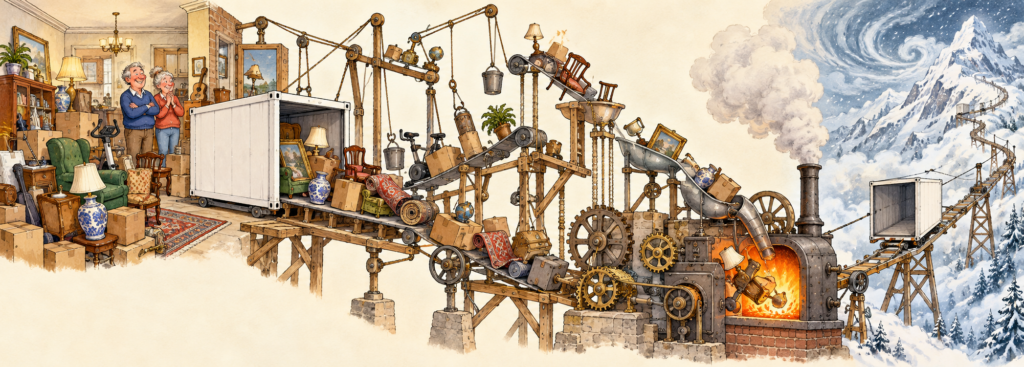
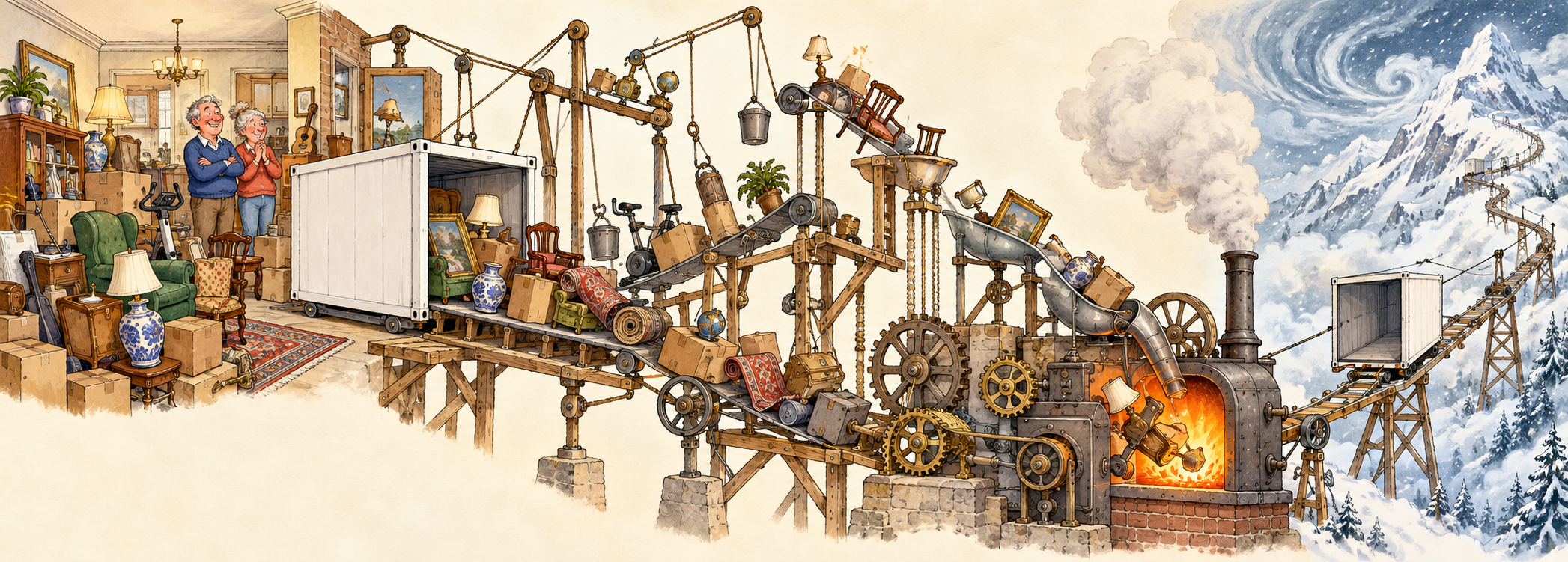
Here is how it works. For just fifty dollars, a handsome container arrives at your home. You fill it with old furniture, inherited china, your children’s school projects and the exercise machine on which you once hung a shirt. We take it away. You regain enough floor space to sneeze.
“You’re charging fifty dollars to store all that?” Kate asked.
“Fifty dollars to collect it. Storage starts at ninety-nine dollars a month.”
“That seems reasonable.”
“Yes. We want people to think so.”
Kate has a suspicious mind, especially when I start agreeing with her.
Our containers are taken to a facility whose location is confidential for security reasons. On arrival, the contents are carefully inventoried, photographed and incinerated. This leaves us with a digital record of every treasured possession and a remarkable amount of available space.
Each month, the customer receives a reassuring invoice. To keep pace with rising costs, the fee increases by eleven dollars. We also offer climate control for an additional twenty-five. Climate control is especially important during incineration, and I feel we should be compensated for it.
For a while, everyone is delighted. Our customers enjoy their uncluttered homes. I enjoy their monthly payments. Kate asks whether I have considered that this is fraud.
“Of course,” I tell her. “I have considered it extensively.”
Eventually, someone wants a box back. This is when POOF’s customer service department earns its salary.
At first, we explain that the container has been delivered to the wrong address. After six weeks of searching, we discover it was sent to another customer who is refusing to return it because she believes the contents belonged to her mother.
If the customer produces photographs of the supposed antiques, we express concern. Then we explain that the container was caught in a flood. This usually ends the conversation, provided the customer has never visited our facility, which is difficult because it does not exist.
One gentleman, however, refuses to give up. He says his grandfather’s desk could survive a flood. I agree. I tell him we had moved the desk to our mountain division as an extra precaution.
“You store desks in the mountains?” he asks.
“Only the irreplaceable ones.”
Unfortunately, a terrible storm has struck our annex on the side of Mount Everest. The desk may now be somewhere in Nepal. We advise him not to look for it until the climbing season begins.
He threatens to sue. I refer him to the contract, which releases POOF from responsibility for acts of God. The list includes floods, lightning, earthquakes, avalanches, volcanic eruptions and “any other event requiring the use of the word unprecedented.”
Our first year is extraordinarily successful. We pay almost nothing for real estate. We own one truck, two containers and an incinerator. Our customers, meanwhile, keep paying to preserve their memories. On paper, their belongings are safe. In their homes, there is room to walk.
I have begun to believe we are providing a valuable service.
Then a customer calls to say she is moving and wants everything returned by Friday. She is willing to pay the delivery charge. I consult her file. Over three years, she has paid us more than four thousand dollars to safeguard a dining table, eight chairs and a box marked CHRISTMAS, FRAGILE.
I tell her there has been an act of nature.
“What kind?” she asks.
I look out the window. The sky is clear. A squirrel is sitting on our balcony railing.
“A highly localized one,” I say.
She asks to speak to the owner. I tell her he is unavailable. He has made so much money that he and his wife are finally moving to a larger condo. “They couldn’t fit one more thing in the old place,” I explain.
“Are they taking their furniture with them?”
I look at Kate. “Most of it,” I say. “I heard they hired a storage company for the rest.”