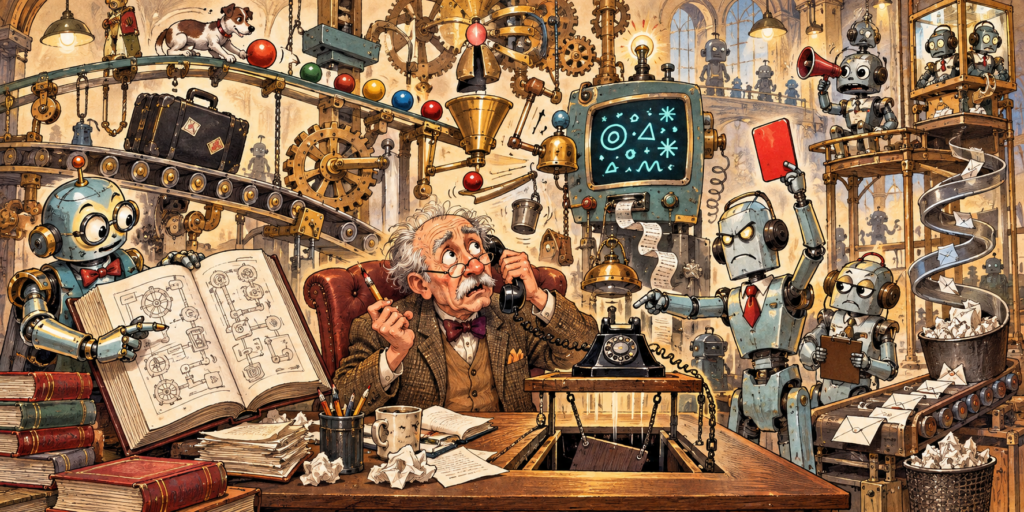

I have a theory about what is wrong with the world.
There may be absolutely no empirical evidence that my theory is right. There is also no empirical evidence that it is wrong, which, as I understand modern debate, makes it practically a scientific fact.
My theory is that the generations no longer understand one another because we keep making assumptions.
Young people assume old people cannot understand technology. Old people assume young people cannot make change without consulting an app. Large corporations somehow manage to assume both things about me at the same time.
They assume I am a near genius—but speak to me as though I am a babbling idiot.
Take AT&T, one of the largest communications companies in the world. I have been a customer for twenty years. This apparently makes me a cherished and valued member of the AT&T family.
When I telephone because my Wi-Fi is not working, a cheerful artificial woman tells me how delighted she is to hear from me.
She does not sound delighted. She sounds like a woman who has been trapped inside a telephone since 1997 and is taking it remarkably well.
She asks whether I would like to speak to technical support or fix the Wi-Fi myself.
I say, “I would like to speak to a human being.”
She replies, “I understand that you are having trouble paying your bill.”
“No. Human being.”
“Certainly. You would like information about international roaming.”
“HUMAN BEING.”
“I’m sorry. I didn’t quite get that.”
Eventually, she connects me to the billing department, where a real person gives me five numbers that I must call to reach technical support.
He assumes I am sitting at a desk with a sharpened pencil, a legal pad and a photographic memory.
In fact, I am crawling across the kitchen floor looking for something that writes.
I find a pencil. It has no lead.
I find a pen. It was manufactured during the Nixon administration and gave up sometime during the Carter years.
After twelve seconds of silence, AT&T assumes I have died.
“Since there has been no response,” the voice says, “we will now end this call.”
Click.
I call again, but AT&T is busy helping other cherished members of its family. By my third attempt, I am informed that I have reached my daily calling limit.
AT&T promises to call me back. A message soon arrives saying:
$$RF^TGY
AT&T assumes I know what this means.
I assume it means, “Your call is extremely important to us, but not important enough to involve an employee.”
Microsoft has even greater faith in my intelligence.
My computer suddenly announces that something has gone wrong and gives me this helpful explanation:
Error 0x80070005
Microsoft assumes I will slap my forehead and say, “Of course! Why didn’t I think of 0x80070005?”
It offers to troubleshoot the problem. I click the button. Several little blue dots chase one another around the screen for five minutes.
Then Microsoft triumphantly announces:
The troubleshooter could not identify the trouble.
This seems harsh. I already knew there was trouble. That was why I summoned the troubleshooter.
Microsoft suggests that I contact my system administrator.
It assumes I have a system administrator.
I look around the room. There is only Kate, and she has wisely left.
Airlines have the same touching confidence in me.
When an airline loses my suitcase, its website tells me not to worry because I can track the suitcase myself.
All I need is the thirteen-character baggage identification number printed on the tiny sticker attached to my boarding pass.
The boarding pass was taken from me at the gate.
The airline assumes that before surrendering it, I photographed the sticker, memorized the number, made two backup copies and stored one in a secure underground vault in Switzerland.
When I finally reach a human being, she asks me to describe the suitcase.
“It’s black,” I say.
“Most suitcases are black,” she replies.
Apparently, the airline assumes that I travel with a fluorescent orange steamer trunk bearing my portrait, fingerprints and dental records.
Then she asks whether I have checked the airline’s baggage-tracking app.
“I don’t want an app,” I explain. “I want my underwear.”
This is where the relationship deteriorates.
After spending forty minutes being treated like a genius who can decode error messages, locate invisible numbers and repair an international communications network with a pencil that has no lead, I occasionally use a word that the corporation considers inappropriate.
Immediately, the artificial intelligence understands me perfectly.
It could not understand “human being.”
It could not understand “my Wi-Fi is broken.”
It could not understand “where is my suitcase?”
But it understands one particular four-letter word with the speed and precision of a Harvard linguistics professor.
A recorded voice tells me, “We will not tolerate abusive language.”
Then it hangs up.
I am punished.
My call may be blocked. My account may be flagged. I may be sent to the back of the electronic line, where I must listen to music composed specifically to make prisoners confess.
So that is my theory.
The problem with civilization is not artificial intelligence, old people, young people or disappearing suitcases.
The problem is assumption.
The corporation assumes I am intelligent enough to repair its equipment, decode its secret messages and remember thirteen-character numbers.
It also assumes I am too stupid to know when I am being driven insane.
And if I object in plain Anglo-Saxon English, it assumes I am the problem.