
October 20, 1995
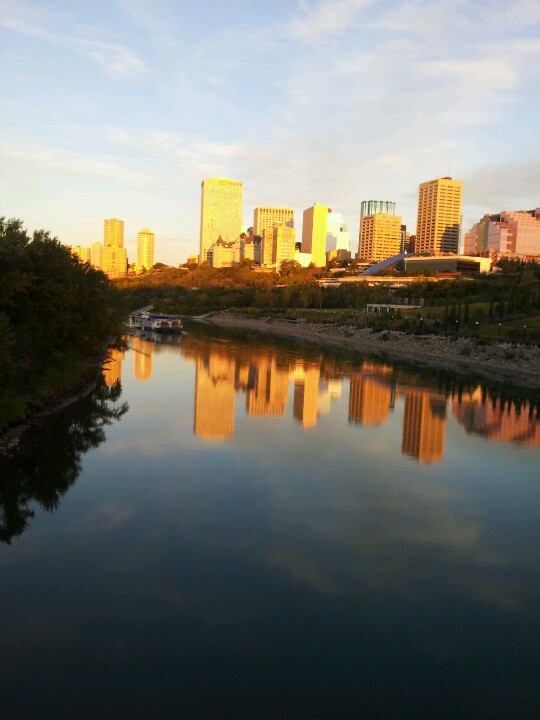
Bon picked me up at 6:30 on a Saturday morning, and within five minutes I remembered why Edmonton may be one of the world’s most underrated cities.
Bon was driving me to the Muni so I could catch a flight to Calgary and then connect with Air Canada. I had never met him before. He arrived exactly on time, which at that hour made him seem less like a cab driver and more like a miracle with headlights.
His name was Bon, and of the world’s ten best smiles, he had two or three of them.
As we tooled along Groat Road, the river valley rolled beside us — parks, bike trails, horse paths, and somewhere down there, probably a beaver swimming through the middle of the city like he owned the place.
The air was perfect, sweet from a recent mowing. You could almost get intoxicated on it. If you think you can’t get high on good old Alberta grass — the kind cows munch on — then you don’t know what high is.
And the sky.
Marshmallow clouds were streaked with sunlight, making the heavens so blue your eyes ached looking upward.
I felt sad I had to leave. On the other hand, if I hadn’t gotten up early, I would have missed the morning.
Lovers are always talking about sunsets, but I suspect the more sunrises a couple sees together, the longer they’ll stay together.
One of the great things about Edmonton is that you get lots of sunsets and sunrises only a few hours apart.
Eat your heart out, Paris and San Francisco, you so-called fabled cities with all those songs written about you.
Soon Bon was driving across Jasper Avenue. The only city I have seen that approaches the pristine quality of Edmonton in early morning is Zurich.
And Zurich is boring.
No cowboys.
Then I saw an elderly Indigenous man staggering down the street and instantly — unfairly — assumed he was drunk.
What a pity, I thought, that one of our country’s Aboriginal people couldn’t appreciate the morning.
Then I noticed the cane.
He wasn’t drunk. He was old.
He staggered the way my mother did at ninety-two, and she didn’t drink anything stronger than Postum.
I felt ashamed. I had stereotyped him in the space of three seconds. If I had seen my mother limping down Jasper Avenue at that hour, I would never have assumed she had been drinking.
I might have wondered what she was doing before the city was awake.
Knocking over parking meters to pay for home care, perhaps.
“Bon,” I said, “do you think there’s a lot of prejudice here?”
“Some,” he said. “People get laconic when you call them on it.”
Bon had three university degrees and savored words such as laconic. His speech was not an affectation. It was part of his charm. He assumed everyone knew laconic meant terse.
We reached the Muni, and Bon said, “People who are prejudiced really hurt themselves.”
“How do you mean?”
“Because if a man decides to hate somebody on sight, then every time he sees that kind of person, he poisons his own day. Most of the people he hates don’t even know about it. But he carries it around.”
Bon was not especially laconic when he was philosophizing.
We shook hands, and he wished me bon voyage.
Half an hour later, as my commuter flight lifted off over Edmonton, I watched the city spread out below, waking up. A familiar yellow car crept across the Low Level Bridge.
I wondered if Bon was in it.
Maybe.
I wondered if he really understood prejudice.
Better than most.
He was Black and had been living in Edmonton for ten years.
Just before I paid him and got out of his cab, he told me how much he liked hacking.
“Gives you a chance to meet so many people,” he said. “It’s a blessing.”
I thought again how lucky I was to be in Edmonton, where people like Bon made their homes.
Saturday morning was the first time we had met. I knew him for twenty-five minutes.
But what a golden twenty-five minutes.
One day, if you’re lucky, you’ll ride with him too.